
Key Takeaways
- Five brush types cover a kitchen: dish brushes, cup and glass brushes, bottle brushes, crevice or detail brushes, and stiff pot and pan scrubbers — plus a powered cup brush if you wash tall vessels daily.
- Handle length and head angle matter more than bristle material for reaching the bottom of a tall glass or a narrow-neck bottle.
- Kitchen brushes carry food residue, so they need their own hygiene rules — a hot soapy wash and a full dry after every use, not just a rinse.
- Replace dish and cup brushes every 3–4 months and bottle brushes every 1–2 months. Replace immediately after raw meat or a contaminated sink.
- Silicone and TPR heads rinse cleaner and last longer than nylon in a kitchen, but nylon still scrubs burnt pans faster.
Introduction
The main types of kitchen cleaning brushes divide by the shape of the thing they clean, not by brand or price. A dish brush has a short handle and a wide head for flat plates. A cup brush is long, narrow and angled to reach the bottom of a tall glass. A bottle brush is longer still, with a flexible shaft that follows the curve of a narrow neck. A crevice brush is thin enough to get into the gap where a sink meets a countertop. A pot scrubber is stiff and abrasive enough to lift burnt food without scratching the pan. Each shape exists because the others cannot reach that particular surface. For example, a dish brush will not reach the base of a tall travel mug, and a bottle brush will not cover a dinner plate in one pass. The crevice shape is covered in depth in how to clean crevices, and the floor-side equivalents in floor brush types.
What makes kitchen brushes different from every other cleaning tool in the house is the contamination they carry. They touch food, they sit in warm water, and they are stored in the dampest room in the home. Consequently, they need their own hygiene rules rather than the general ones applied to a floor brush. Research on kitchen cleaning tools supports that: a study of used kitchen sponges published in Scientific Reports found dense microbial communities, with up to 54 billion bacteria per cubic centimetre and hundreds of species detected (Cardinale et al., 2017). A brush has less internal volume than a sponge, but it shares the same warm, wet, nutrient-rich working conditions. In our experience, the brush is often the cleanest-looking tool in the kitchen and the one carrying the most residue.
This guide covers the five brush types, the materials they are made from, and the storage and replacement habits that keep a kitchen hygienic. Notably, we manufacture all five categories, so the comparisons below come from our own product testing rather than from a catalogue description.
The Five Kitchen Brush Types at a Glance
Use this table to work out which brushes your kitchen is missing. In contrast to a general cleaning kit, a kitchen benefits from having several specialised heads rather than one general-purpose brush, because the surfaces differ so much in shape.
| Type | Shape | Best for | Bristle stiffness | Replace |
|---|---|---|---|---|
| Dish brush | Short handle, wide flat head | Plates, bowls, cutlery, pans | Medium | 3–4 months |
| Cup and glass brush | Long handle, angled or rounded head | Tall glasses, mugs, cups, vases | Soft to medium | 3–4 months |
| Bottle brush | Long flexible shaft, narrow head | Bottles, flasks, baby bottles, thermoses | Soft | 1–2 months |
| Crevice brush | Thin flat or pointed head | Sink edges, tap bases, tile grout, appliance seals | Stiff | 6–12 months |
| Pot and pan scrubber | Short wide head or pad holder | Burnt pans, baking trays, grills | Very stiff | 2–4 months |
Dish Brushes
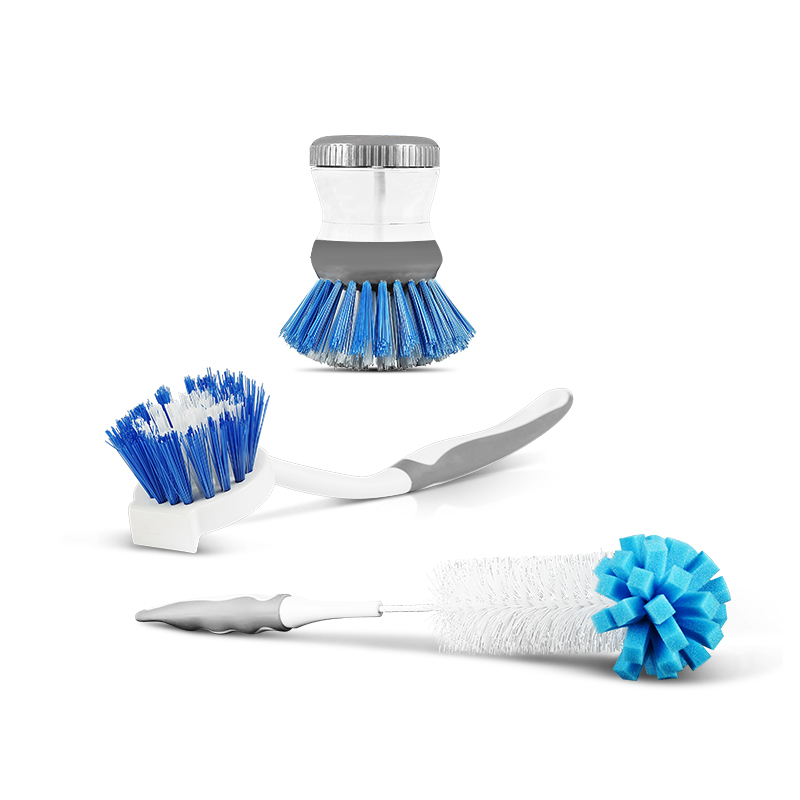
A dish brush is the workhorse of the category: a short handle with a wide, flat head of medium-stiff bristles, sized to cover a plate in two or three passes. Its advantage over a sponge is reach and rinsing. A brush lifts food off a surface and releases it under the tap, while a sponge holds the residue inside its own structure until you replace it. For anyone who has ever smelled a sponge that was left damp overnight, that difference is the entire argument. In addition, a dish brush lets you clean a hot pan without putting your hand in the water. We found that the rinse step matters more than the soap, because food released under running water does not return to the head.
Two variations are worth knowing. Some dish brushes carry a soap reservoir in the handle, which dispenses detergent through the head as you scrub; these are convenient for light washing but need rinsing out, because detergent left in the reservoir thickens and clogs. Others have a replaceable head that clicks onto the handle, which cuts the long-run cost considerably. In our testing, the replaceable-head design outlasted a fixed-head brush by roughly three to one on cost, because the handle is what fails last. For most kitchens, one dish brush at the sink plus a spare head in a drawer covers everything. In contrast, a soap reservoir is convenient but needs rinsing out after every use, because thickened detergent will clog the head.
JESUN Kitchen Cleaning Brush Set (ALM11)
Multi-head PP, PET and sponge set on a 36×8 cm handle, 0.046 kg per brush. Covers the dish, cup and detail jobs from one handle.
Cup and Glass Brushes
A cup brush solves a geometry problem that a dish brush cannot. Tall glasses, travel mugs and narrow vases have walls too deep for a short handle and a bottom too wide for a bottle brush, so the head needs to be long, angled and rounded to reach the base without scraping the sides. The angled-head version is the more useful design, because the angle lets the bristles meet the bottom of the glass while your hand stays above the rim. Consequently, you can clean a full-depth mug without soaking your fingers in dishwater. Similarly, a straight-handled cup brush can clean the sides but struggles to reach the base without bending, which is why the angled design has become the standard.
Material choice matters here more than elsewhere, because glass and glazed ceramic scratch visibly. Soft nylon or silicone bristles will lift tea and coffee residue without leaving a haze, while a stiff brush used with pressure will dull the surface over time. Notably, an electric cup brush shortens the job for anyone washing several cups a day, and the rotating head reaches the base more consistently than a manual pass. Both variants need the same care: rinse after use, stand the head up to dry, and replace the head before the bristles flatten. Consequently, we tested both head types on glazed mugs and found no visible scratching from either while the pressure stayed light, which supports the general rule that pressure rather than material causes damage.
Bottle Brushes
A bottle brush is defined by its shaft. To clean a narrow-neck bottle, a flask or a baby bottle, the shaft has to be long enough to reach the bottom and flexible enough to follow the shoulder of the bottle as it narrows. The head is usually a small radial tuft or a foam tip, and the bristles are soft so they do not scratch the inside of a plastic bottle. For baby bottles and water flasks, that reach is not a convenience but a requirement, because residue left at the base of a bottle is exactly where biofilm forms. Specifically, a film of milk or juice left at the base of a bottle becomes a biofilm that a quick rinse will not remove.
Two design details decide whether a bottle brush works in practice. First, the handle should have a hook or a hanging hole, because a bottle brush stored flat on a sink never dries. Second, the head should be replaceable or at least firm enough to survive being pushed into a narrow neck repeatedly. For example, a brush with a wire core will eventually bend and stay bent, while a moulded plastic or silicone shaft keeps its shape. In our experience, households that clean flasks and baby bottles daily should keep two brushes and rotate them, so one is always fully dry. As a result, the cheapest improvement to a bottle brush routine is a second brush rather than a stronger detergent.

JESUN Silicon Small Bottle Cleaning Brush (FSR0022)
PP and TPR head on a 30×3.5×3 cm shaft, 0.025 kg, with a flexible tip that follows a narrow neck. The soft-tuft profile for flasks, sports bottles and baby bottles.
Crevice and Detail Brushes
A crevice brush is the smallest tool in the kitchen and often the one that removes the most visible grime. Its head is thin and flat or pointed, so it fits the seam where a sink meets a countertop, the base of a tap, the groove around a hob, and the rubber seal of a fridge door. These are the places where a normal brush cannot reach and where residue accumulates out of sight until it discolours or smells. Specifically, the gap behind a tap base and the channel along a sink edge are two of the most common sources of persistent kitchen odour. Notably, a crevice brush is also the only tool that reaches the seal around a dishwasher door.
The trade-off is fragility. Crevice brushes are thin by design, so the bristles wear quickly and the head can snap if you apply sideways pressure. Use them with a light touch and let a cleaning solution do the work rather than forcing the bristles into a gap. In addition, keep a crevice brush dedicated to the kitchen rather than moving it between rooms, because a brush used on a bathroom seal should never touch a food preparation surface. Replacing one every six to twelve months is normal, and the cost is trivial. Similarly, keep the head thin and let it follow the gap rather than forcing it into place, because a snapped head is the most common failure in this category.
Stiff Pot and Pan Scrubbers
The stiff end of the kitchen brush range exists for burnt food. A pot scrubber uses very stiff bristles, an abrasive pad or a combination of both to lift carbonised residue from a pan, a baking tray or a grill grate. Nothing softer will do the job, and the alternative, steel wool, scratches stainless steel and destroys non-stick coatings. Consequently, a stiff brush with a replaceable head is the safer choice for anyone who cooks often enough to burn something regularly. Choose the head material to match the cookware rather than the price. In addition, an abrasive pad holder gives you the option of changing the pad without replacing the handle, which lowers the cost of owning a stiff scrubber.
Non-stick pans need the most care. Even a stiff brush can dull a coating if you press hard on a hot surface, so use the softest head that will shift the residue and soak the pan first. Cast iron is the opposite case: it tolerates a stiff brush, but it should not be scrubbed with detergent, because that strips the seasoning layer that makes the surface non-stick in the first place. Meanwhile, stainless steel and enamel can take a stiff brush and an abrasive pad without complaint. Matching the brush to the pan is what prevents damage.
Electric Spin Brushes and Cup Brushes
The one category worth adding to the five above is powered. An electric spin brush puts a small motor in the handle and rotates the head, which removes the repetitive wrist motion from the job. In a kitchen the most useful version is not a general scrubber but an electric cup brush, because the task it solves is the one a manual brush does worst: cleaning the inside of a tall cup or a narrow bottle, where the head has to keep turning while your hand stays outside the vessel. It also helps anyone who finds scrubbing painful, which is the same argument that makes powered brushes popular in bathrooms. The trade-off is the usual one: a battery to charge, a head that still wears out on the same cycle, and a higher purchase price than a manual brush that does eighty percent of the same work.
If you buy one powered kitchen tool, buy a cup brush rather than a powered pan scrubber. Pans need pressure rather than rotation, so a stiff manual head with a scraper edge still wins on burnt residue, while a cup or bottle needs rotation and reach, which is exactly what the powered version supplies. In addition, keep the battery out of the sink: most of these brushes are water-resistant rather than waterproof, and the charging port is usually the first thing to fail when it is left wet.

JESUN Electric Cup Brush Set (JCS001)
Powered PP and TPR brush set, 16×11.2×4.3 cm, 0.3 kg, with an 800 mAh battery. Built for the inside of cups, glasses and narrow containers where a manual head cannot keep turning.
Bristle Materials Compared
Bristle material decides how long a kitchen brush lasts and how clean it rinses. Nylon is the stiffest common option and the best for burnt pans, but it discolours with heat and degrades with repeated bleach exposure. Polypropylene is softer and cheaper, which suits dish and cup brushes where scrubbing power matters less. TPR rubber sits in the middle, with flexible blades that rinse clean and resist splaying. Silicone is the most hygienic option, because it is non-porous and dries fast, though it applies less pressure than nylon. Sisal and other natural fibres are biodegradable and pleasant to hold, but they absorb water and need faster replacement. However, a natural-fibre brush that stays wet will develop a smell within weeks and should be dried carefully.
| Material | Stiffness | Drying | Chemical resistance | Best kitchen use |
|---|---|---|---|---|
| Nylon | Highest | Slow | Fair; degrades with bleach | Burnt pans, grill grates |
| Polypropylene | Medium | Slow | Good | Everyday dish washing |
| TPR rubber | Medium to high | Fast | Very good | Dish and cup brushes |
| Silicone | Soft to medium | Fastest | Excellent | Bottle and baby bottle brushes |
| Natural fibre | Medium | Slowest | Poor with bleach | Light dish washing, eco ranges |
Hygiene Rules for Kitchen Brushes
Kitchen brushes need stricter handling than any other cleaning tool because they touch food surfaces. Wash the head in hot soapy water after every use rather than just rinsing it, shake it out, and stand it up to dry where air can reach the bristles. Once a week, wash the head and the holder together, and use a disinfectant only when the situation calls for it. Public health guidance is that cleaning with soap and water removes most germs in ordinary household settings, and disinfection is reserved for when someone is sick or a surface has been contaminated (CDC, 2025). Following that order keeps the routine short and effective. In addition, washing the holder matters as much as washing the head, because the holder collects the same residue.
Three specific rules matter more than the rest. First, keep a separate brush for raw meat preparation, or wash the brush thoroughly immediately afterwards, because cross-contamination from a brush to a salad is easy to miss. Second, never leave a brush standing in dirty dishwater, since that is the ideal environment for growth. Third, replace the brush after any stomach illness in the household. An NSF International study reported by Consumer Reports found coliform bacteria on 75% of sampled household sponges and rags, and extension services at US universities make the same point about dish brushes that are not washed and dried between uses (Consumer Reports, 2025). A brush is not exempt from that pattern simply because it has bristles. Importantly, the risk is highest on the surfaces you cannot see, which is why a light touch and a thorough rinse beat hard scrubbing.
How to Choose Kitchen Brushes for Your Setup
Start with what you actually wash, then buy the shapes that match. The list below covers the minimum useful set for a normal household kitchen.
- One dish brush with a replaceable head, kept at the sink and rinsed after every use.
- One cup or glass brush if you use tall glasses, travel mugs or vases regularly.
- One bottle brush if anyone in the house uses a flask, a sports bottle or a baby bottle.
- One crevice brush for sink edges, tap bases and appliance seals, kept out of the dishwater.
- One stiff scrubber for pans and trays, chosen to suit whether your cookware is non-stick or stainless steel.
Then decide on materials. If your priority is hygiene and easy rinsing, silicone and TPR heads are the better default. If your priority is scrubbing power on burnt pans, nylon is still unbeatable. For a mixed kitchen, the sensible combination is silicone for bottles and cups, TPR for dishes, and nylon for pots. In addition, buy brushes with replaceable heads where the design offers them, because the handle rarely fails before the bristles do.
Frequently Asked Questions
What are the main types of kitchen cleaning brushes?
Five types cover most kitchens: dish brushes for plates and pans, cup and glass brushes for tall vessels, bottle brushes for narrow-neck containers, crevice brushes for sink edges and appliance seals, and stiff pot and pan scrubbers for burnt food.
Are brushes more hygienic than sponges in the kitchen?
Generally yes. A brush releases food residue under the tap instead of holding it inside a porous structure, and it dries faster because air can move through the bristles. Research on kitchen sponges has found very dense bacterial communities, which is why sponges are usually replaced weekly while a brush lasts months.
How often should I replace kitchen brushes?
Replace dish and cup brushes every three to four months and bottle brushes every one to two months. Stiff pot scrubbers last two to four months and crevice brushes six to twelve months. Replace immediately after use on raw meat, after a stomach illness in the household, or whenever the bristles flatten or a smell persists after washing.
Can I put kitchen brushes in the dishwasher?
Most plastic and silicone brush heads tolerate a dishwasher cycle on the top rack, and it is an effective way to sanitise them. Check the manufacturer’s guidance first, since natural-fibre brushes and some adhesive joints will not survive the heat. Air drying afterwards matters as much as the wash itself.
Do I need a separate brush for raw meat?
Ideally yes. A brush used on a board or sink that has held raw meat can transfer bacteria to the next surface it touches, and that risk is easy to overlook during a busy clean-up. If you use one brush for everything, wash it thoroughly in hot soapy water immediately after the raw-meat step.
Which bristle material is best for kitchen brushes?
It depends on the job. Nylon is stiffest and best for burnt pans, polypropylene suits everyday dish washing, TPR rubber rinses clean with moderate stiffness, and silicone is the most hygienic because it is non-porous and dries fastest. Many kitchens use silicone for bottles and cups, TPR for dishes, and nylon for pots.
Sourcing kitchen brushes for your range?
We manufacture dish, cup, bottle, crevice and pot scrubber brushes in nylon, TPR and silicone, including soap-dispensing handles, with OEM and ODM support from low MOQs.
Request Wholesale Pricing →Conclusion
Kitchen cleaning brushes are shaped by the objects they clean, and that is why one brush is never enough. A dish brush handles flat surfaces, a cup brush reaches the base of a tall glass, a bottle brush follows a narrow neck, a crevice brush gets into the seams, and a stiff scrubber deals with burnt pans. Materials then decide how long each one lasts and how easily it rinses clean, with silicone and TPR leading on hygiene and nylon leading on scrubbing power. Meanwhile, the habits that matter most are simple: wash after every use, dry standing up, keep raw-meat contact separate, and replace on schedule rather than on appearance. That said, none of it works if the brush stays wet, so drying remains the habit that matters most.
We build all five categories in nylon, TPR and silicone, including soap-dispensing handles, and we are happy to help you assemble the right range for your market.
References
- Cardinale M, Kaiser D, Lueders T, Schnell S, Egert M — “Microbiome analysis and confocal microscopy of used kitchen sponges reveal massive colonization by Acinetobacter, Moraxella and Chryseobacterium species,” Scientific Reports 7:5791, 2017. nature.com/articles/s41598-017-06055-9
- US Centers for Disease Control and Prevention — “When and How to Clean and Disinfect Your Home.” cdc.gov/hygiene/about/when-and-how-to-clean-and-disinfect-your-home.html
- Consumer Reports — “Household Cleaning Tools: How to Clean and When to Replace.” consumerreports.org/home-garden/cleaning/how-to-clean-and-when-to-replace-household-cleaning-tools
- University of Illinois Extension — “A guide to keeping your sponges, dish rags and scrub brushes clean.” extension.illinois.edu/blogs/simply-nutritious-quick-and-delicious
This guide was written by the JESUN Cleaning Tools Team and reviewed by our product engineering group. You can read more about us or contact our team with questions about kitchen brush specifications.
Continue Learning
- What Is the Proper Method for Cleaning Dirty Utensils? — the washing order that keeps a kitchen hygienic.
- Kitchen brush catalog — dish, cup and scrub brushes in nylon, TPR and silicone.
- Bottle brush catalog — flexible-shaft brushes for flasks and baby bottles.




 English
 Spanish
 Russian
 Arabic