
Key Takeaways
- Most stains come back because of wicking: liquid drawn up the fibre as the carpet dries, which brings the pigment with it.
- Blot, never rub. Rubbing pushes the stain into the backing and fuzzes the pile, and neither is reversible.
- Try water before chemistry. Most household spills are water-soluble, and leftover cleaner residue attracts new soil.
- Give the cleaner three to five minutes of dwell time rather than scrubbing harder, and use cold water on protein stains.
- Finish with a dry extraction pass and something weighted on the area, then check it again the next day before you call it done.
Introduction
Carpet staining is mostly a timing problem, and the tools matter less than the first five minutes. Liquid that sits on a fibre begins to move down into the backing and then sideways into the underlay, and once it has spread, no surface treatment removes all of it. That is why the sequence below starts with what you do before you fetch anything: remove the solids with a spoon or a blunt edge, then blot with a clean cloth rather than wiping across the spill, because wiping spreads the liquid over a larger area and pushes it deeper. Everything after that is about extraction and about drying the fibre so the pigment does not return.
The chemistry matters in a narrower way than most advice suggests. Liquid drawn up the fibre as the carpet dries brings the pigment with it, which is why a stain that looked gone at noon can be visible again by evening, and why the final step is a dry extraction pass rather than another wet one. Meanwhile, leftover cleaner residue is itself a soil magnet, so a stain treated with too much chemistry often attracts new dirt and looks grubby again within a week. Public health guidance keeps the same distinction for surfaces generally: cleaning removes most household soil and germs, and disinfection is reserved for specific contamination events rather than applied as routine (CDC, 2025).
This guide covers the first five minutes, the wicking mechanism, the order that works for most stains, what different stain types need, how to run a spot cleaner properly, and the mistakes that set a stain permanently. In our experience, the two habits that change most outcomes are blotting instead of rubbing, and checking the area again the next day instead of assuming it is finished when the surface looks clean. Notably, both habits are free, which is why they are worth stating before any product advice.
The First Five Minutes
Speed decides how much of the stain you will ever remove, so the first five minutes are about containment rather than chemistry. Remove any solid material with a spoon or the blunt edge of a knife, working towards the centre of the spill so you do not push it outwards. Then blot with a clean, absorbent cloth, pressing down and lifting rather than wiping sideways, and change the cloth as soon as a section is saturated, because a loaded cloth simply redistributes what it has already taken up.
Two details in these minutes make a large difference later. Do not add liquid yet, because adding water to a fresh spill dilutes it and spreads it sideways into a larger area of backing. And do not rub, because friction abrades the pile and forces the pigment into the fibre structure, where extraction cannot reach it. In our experience, a spill blotted properly in the first five minutes leaves a faint mark that comes out with one cleaning pass, while the same spill rubbed for the same length of time leaves a permanent shadow. Once the surface is blot-dry, the rest of the process can proceed calmly. Meanwhile, if the spill has already dried, dampen it with cool water and wait a minute before blotting, because a dried stain releases more readily than a scrubbed one.
Why Stains Come Back: Wicking
Wicking is the reason a treated stain reappears, and understanding it explains the whole method. Carpet and underlay act like a wick: liquid travels towards the surface as the fibre dries, because evaporation at the surface draws more liquid up behind it. If the stain has reached the backing, the liquid that returns to the surface carries pigment with it, so the mark reappears as a faint outline even though the surface looked clean an hour earlier. The practical consequence is that treating the visible surface without extracting from depth simply resets the clock. Consequently, a stain that is cleaned and then checked a day later tells you the truth about whether it is gone.
Three steps counter it. First, extract rather than wipe, because a machine pulls liquid out of the pile instead of pushing it around. Second, do a dry extraction pass at the end, which removes the liquid sitting in the fibre so there is less to wick upward as the area dries. Third, put something weighted over the area while it dries, because pressure keeps the fibre compressed and slows the upward movement of liquid, and check the spot again the next day. Notably, the same mechanism applies to pet accidents, which is why the odour can return days later: liquid that reached the underlay keeps releasing smell as it wicks back to the surface, and the fix is extraction plus an enzyme treatment rather than more surface cleaning.
| Step | What to do | Why | What not to do |
|---|---|---|---|
| 1. Remove solids | Spoon or blunt edge, working inwards | Stops the spill spreading before you add anything | Do not wipe outwards |
| 2. Blot | Press and lift with a clean cloth, changing it often | Removes liquid without spreading it | Do not rub or scrub |
| 3. Water first | Dampen and blot with clean water | Most spills are water-soluble; residue attracts soil | Do not soak the backing |
| 4. Cleaner | Apply, then leave 3–5 minutes | Dwell time does the work rather than scrubbing | Do not apply more than needed |
| 5. Extract | Wet pass with the spot cleaner, then a dry pass | Pulls liquid and pigment out of the pile | Do not over-wet the area |
| 6. Weight and dry | Lay a cloth over it, weight it, check next day | Slows wicking while the fibre dries | Do not walk on it wet |
The Order That Works
Work through the sequence as written rather than improvising, because each step depends on the one before it. After blotting dry, treat with clean water first: dampen a cloth or apply a light mist, blot, and see how much comes out. Most household spills are water-soluble, and plain water removes them without leaving the residue that a cleaner leaves behind. If the stain remains, apply the appropriate cleaner, give it the dwell time on the label — usually three to five minutes — and then extract.
Extraction is where a spot cleaner earns its place. Make a wet pass to pull the loosened pigment out of the pile, then a dry pass over the same area to remove the liquid that remains, and repeat wet and dry passes until the water you pull out runs clear. Then place a clean cloth over the area, weight it with something heavy and flat, and leave it for a few hours so the fibre dries under pressure rather than wicking. In our experience, skipping the dry pass is the single most common reason a stain returns, because the liquid left in the fibre is what carries the pigment back to the surface overnight. Check the area the next morning before you consider the job closed.
Stain Types and What Each Needs
Four categories cover most household spills, and they need different treatment. Water-soluble stains — coffee, tea, most soft drinks, mud — respond to water first and a neutral cleaner second, and they are the easiest to remove completely. Greasy stains such as cooking oil, butter and some cosmetics need an alkaline or solvent-based cleaner, because water alone will spread the oil rather than lift it. Protein stains — pet urine, milk, blood, egg — need a cold-water rinse and an enzyme cleaner, because hot water sets protein and bleach can fix the pigment permanently. Tannin stains such as wine, tea and fruit juice respond to a mild acid or a dedicated tannin remover, and they are the ones most likely to reappear through wicking.
Two rules apply across all four categories. Test any cleaner on a hidden part of the carpet first, because some carpets are dye-sensitive and a colour-safe product for wool may not be safe for a synthetic. Importantly, testing takes a minute and prevents a permanent light patch in the middle of a room. And avoid over-wetting: a carpet that is soaked through can delaminate its backing, which is a permanent failure rather than a stain. Notably, the same care applies to pet accidents, where the priority is extraction and an enzyme treatment rather than a strong chemical, because the odour comes from residue the enzyme breaks down and the chemical merely masks.

JESUN Carpet & Upholstery Spot Cleaner (W07)
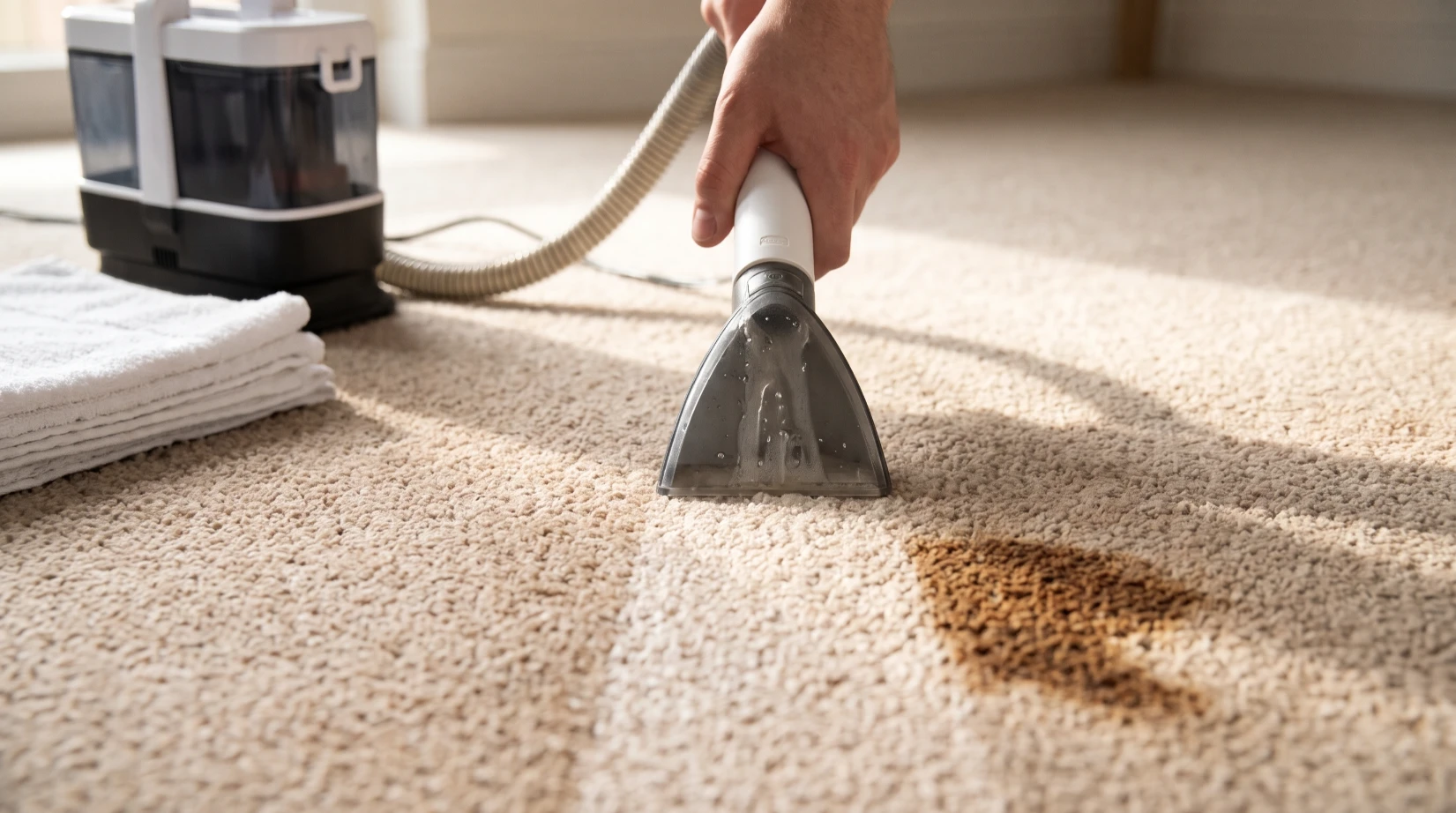
Spot cleaner for carpet and upholstery, 4.7 kg, with a handheld extraction tool. Delivers the wet pass and the dry pass that remove pigment from the pile rather than pushing it deeper into the backing.
Using a Spot Cleaner Properly
A spot cleaner sprays solution, agitates lightly and extracts, and the extraction is the part people under-use. Run the wet pass slowly, because the nozzle needs contact time to pull liquid out of the pile, and then run a dry pass over the same area to remove what is left. Repeat the pair until the extracted water is clear, which is the objective signal that the pigment is out rather than merely diluted. Meanwhile, keep the passes overlapping so you do not leave a stripe of half-cleaned carpet beside a clean patch, which is visible under side light.
Two operating habits protect the carpet. Use the tool’s agitation rather than scrubbing by hand, because the machine’s brush is designed for the pile while a hand brush tends to fuzz it. And empty the dirty water tank before it is full, because a full tank reduces suction at exactly the point when you need extraction most. In our experience, a spot cleaner that is run with wet and dry passes and a clean tank removes stains that a spray bottle and a cloth cannot touch, and the difference is the extraction rather than the chemistry. For a whole room rather than a spot, the same logic scales up to a full carpet cleaner, and the dry pass matters just as much.
Five Mistakes That Set a Stain
Rubbing instead of blotting. Friction pushes pigment into the fibre structure and abrades the pile, and both effects are permanent. Press and lift, and change the cloth often rather than working the same patch.
Over-wetting the area. Too much liquid spreads the stain sideways into the backing and the underlay, which turns a small mark into a wide one and can delaminate the carpet. Use a light mist or a damp cloth, not a pour.
Using hot water on protein stains. Heat coagulates protein, which fixes the stain rather than lifting it. Use cold water for pet accidents, milk, blood and egg, and add an enzyme cleaner for the residue.
Applying more cleaner when the first attempt fails. Extra chemistry leaves residue that attracts new soil, so the area looks grubby again within days. Dwell time and extraction solve more stains than a stronger dose.
Stopping before the dry pass and the next-day check. A carpet that looks clean while damp can show the stain again once it dries through wicking. Extract dry, weight the area, and look at it again the next morning before you decide it is finished.
Frequently Asked Questions
How do you use a spot cleaner on carpet?
Remove solids, blot with a clean cloth, try clean water first, then apply the cleaner and leave it for three to five minutes. Run a wet extraction pass, then a dry pass, and repeat until the extracted water is clear. Weight a cloth over the area while it dries and check it again the next day.
Should you blot or rub a carpet stain?
Blot, always. Rubbing pushes the pigment into the fibre and the backing, where extraction cannot reach it, and it abrades the pile so the area looks fuzzy even after the colour is gone. Press down and lift, and change the cloth as soon as it is saturated.
Why does a carpet stain come back after cleaning?
Wicking: liquid travels back up the fibre as the carpet dries and carries pigment with it. Prevent it by extracting thoroughly, finishing with a dry pass, and weighting a cloth over the area while it dries. Check the spot the next day, because a damp area can look clean before it dries.
Can you use a spot cleaner on upholstery?
Yes, with care. Check the upholstery code first, test on a hidden area, and use less moisture than you would on carpet, because foam and filling hold water and can mark. Extraction with a dry pass afterwards matters even more on furniture than on a floor.
How long should carpet cleaner sit before you extract it?
Usually three to five minutes, which is the dwell time most labels specify. The cleaner needs time to break the bond between the pigment and the fibre; scrubbing harder instead of waiting is what damages the pile and leaves residue that attracts new soil.
Sourcing spot cleaners and extraction tools?
We manufacture carpet and upholstery spot cleaners, wet and dry spot vacuums and fabric extraction units with washable components, plus OEM or ODM packaging, from low MOQs.
Request Wholesale Pricing →Conclusion
Removing a carpet stain is mostly a question of sequence and restraint: blot rather than rub, try water before chemistry, give the cleaner its dwell time, extract with a wet pass and then a dry one, and check the area again the next day. The tool matters at the extraction step, because pushing liquid around cannot remove pigment that has moved into the fibre. That said, the two mistakes that cause most permanent marks are both about force — rubbing a fresh spill, and soaking an area to compensate for a first attempt that did not work.
We build spot cleaners and extraction units with washable tanks and hoses, and we are happy to help you match a range to the carpets and upholstery your market actually cleans.
References
- US Centers for Disease Control and Prevention — “When and How to Clean and Disinfect Your Home” (cleaning with soap and water removes most germs and soil in ordinary household settings; disinfection is reserved for specific situations such as illness in the home). cdc.gov/hygiene/about/when-and-how-to-clean-and-disinfect-your-home.html
- Star Maids — “How to Remove Pet Hair From Furniture and Carpet Fast” (match the tool to the material; move tools in gentle single-direction strokes rather than scrubbing back and forth, which pushes what you have gathered back into the weave). starmaidsus.com/remove-pet-hair-from-furniture-carpet
- Westwood JCN, Mitchell MA, Legacé S — “Hospital Sanitation: the Massive Bacterial Contamination of the Wet Mop,” Applied Microbiology 21(4):693–697, 1971 (wet cleaning tools stored between uses were the source of widespread contamination; drying and correct storage broke the cycle). journals.asm.org/doi/10.1128/am.21.4.693-697.1971
- Consumer Reports — “Best Vacuums for Hardwood Floors” (a small dustbin may need emptying more than once during a sizable clean; tool storage and attachments). consumerreports.org/appliances/vacuum-cleaners/best-vacuums-for-hardwood-floors
- University of Illinois Extension — “A guide to keeping your sponges, dish rags and scrub brushes clean” (cleaning tools that are not washed and dried between uses become a contamination source rather than a cleaning aid). extension.illinois.edu/blogs/simply-nutritious-quick-and-delicious
This guide was written by the JESUN Cleaning Tools Team and reviewed by our product engineering group. You can read more about us or contact our team with questions about spot cleaner specifications.
Continue Learning
- How to Deep Clean Carpets Without Harsh Chemicals — the whole-room version of the same method.
- How to Remove Nail Polish from Carpet — a solvent stain with its own rules.
- Vacuum cleaner manufacturer — spot cleaners, wet/dry and cordless lines in bulk.

 English
 Spanish
 Russian
 Arabic