
Key Takeaways
- Tile and grout are two different surfaces and need two different tools: a mop for the tile face, a stiff narrow brush for the joint.
- Match the cleaner’s pH to the soil, not to the room. Acids dissolve mineral scale but attack cement grout; alkalis cut grease; neutrals are for routine passes.
- Cementitious grout is porous and should be sealed; epoxy grout is close to non-porous and does not need sealing at all.
- Never use an acid cleaner as a routine grout cleaner — it dissolves the cement gradually, and the damage reads as wear rather than as a cleaning mistake.
- Resealing is decided by a water test rather than by the calendar: reseal when water stops beading on the joint.
Introduction
Cleaning a tiled floor means cleaning two surfaces that behave nothing alike. The tile face is glazed or sealed and mostly impervious, so it releases soil easily and tolerates a wet mop. The joint between the tiles is a different material entirely: cementitious grout is porous and can absorb a stain, which is why a floor can look clean overall while the grout lines stay dark. That difference explains almost every mistake people make on tiled floors, including the most common one, which is treating the grout as if it were tile and cleaning it with whatever is in the bucket.
The chemistry matters as much as the tools. Grout cleaners are not interchangeable, and the quickest way to predict what one will do is its pH. Acidic cleaners dissolve mineral deposits but also attack cement grout and calcareous stone, while alkaline cleaners cut grease and organic soil and are generally safe on cement grout, and neutral cleaners are the safe default for routine passes (Grout Atlas, 2026). Consequently, using an acid descaler as an everyday grout cleaner damages the joint gradually, and the damage reads as ordinary wear rather than as something the cleaner caused. That delay is exactly what makes the mistake so common.
This guide separates the tile job from the grout job, gives the pH-to-soil matching rule, covers the routine and deep clean, and explains the difference between cementitious and epoxy grout — including the fact that one of them never needs sealing. In addition, it covers the five mistakes that shorten a tiled floor’s life. In our experience, the floors that stay looking new are not cleaned more often. They are cleaned with the right chemistry for the joint, and the joints are sealed before they get dirty rather than after. We tested both approaches on the same shower floor for a year, and the sealed side needed one deep clean where the unsealed side needed four.
Tile and Grout Are Two Jobs
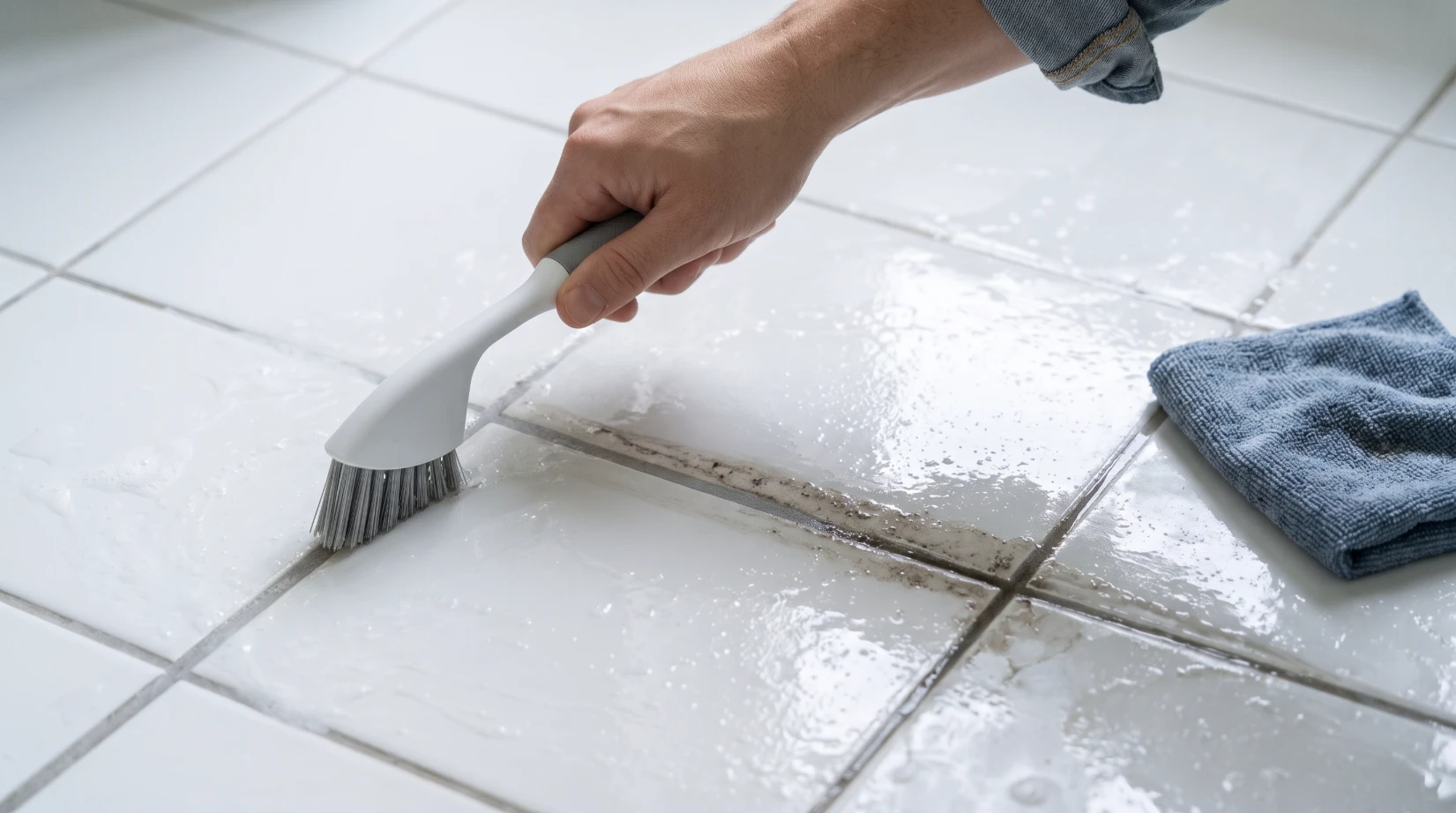
Split the work in two and both halves get easier. The tile face is a hard, non-porous surface, and it needs a mop with a flat head and a neutral cleaner, applied with enough moisture to lift footprints and film but not enough to pool in the joints. A microfibre flat mop is the right tool here because it covers the field quickly and releases water evenly. The joint is a narrow recess, and it needs a stiff, short-tufted brush that can enter the groove and stay in contact with the sides, which a flat mop cannot do because its pad rides over the top.
That division is why a mop alone never fixes dark grout. The pad passes over the recess and polishes the surface above it, so the line stays dark no matter how many times you mop. Notably, the same principle applies to the tools’ care: a grout brush works in a wet recess and needs rinsing and drying after every use, while a flat mop pad needs the warm-water wash that keeps microfibre gripping. Meanwhile, a steam mop sits between the two jobs: it is excellent on the tile face because the surface tolerates heat, and it is fine on cement grout as long as you are not steaming daily, because constant heat and moisture accelerate sealer breakdown in a wet area. For example, a weekly steam pass on a bathroom floor is fine, while a daily one will shorten the life of the sealer noticeably.
Matching the Cleaner to the Soil
The rule is short: acids for minerals, alkalis for oils and organic soil, neutrals for maintenance. A white, chalky or crusty deposit is mineral scale, and an acidic descaler dissolves it. A dark, greasy or sticky line is organic soil, and an alkaline cleaner lifts it. A floor that is merely dull needs neither, and a neutral cleaner will do the job without putting the joint at risk. Getting this wrong is the most common cause of a floor that looks worse after cleaning than before, because the wrong chemistry either leaves the soil in place or attacks the surface you were trying to protect.
Two cautions come with the acidic option. First, acid is a targeted treatment rather than a routine cleaner: a flooring-products manufacturer states plainly that acid-based products are not recommended for polished marble and other types of stone, and that powdered cleanser is not recommended for unsealed or unglazed tile (LATICRETE, 2024). Second, dwell time matters more than strength. An acid left on a cement joint for ten minutes does more damage than a weaker one left for two, and neither removes soil that has to be agitated out with a brush anyway.
| Soil on the floor | What it looks like | Right chemistry | Tool |
|---|---|---|---|
| Mineral scale | White, chalky, crusty; worse near a shower or tap | Acidic descaler, targeted and rinsed | Stiff narrow grout brush |
| Grease and body oil | Dark, sticky, slightly tacky joint lines | Alkaline cleaner or degreaser | Stiff narrow grout brush |
| Soap scum | Grey film with a waxy feel | Mildly acidic or a dedicated scum remover | Brush, then flat mop to rinse |
| Routine dust and film | Dull surface, no visible deposit | Neutral cleaner, pH 7–9 | Microfibre flat mop |
| Mould in a wet joint | Black speckling that returns after cleaning | Alkaline cleaner plus improved drying and ventilation | Brush, then dry thoroughly |
The Routine Clean
The routine pass is for dust, footprints and light film, and it should be quick. Sweep or vacuum first, because grit under a mop acts like sandpaper on a glazed finish. Then mop with a flat microfibre head and a neutral cleaner, working from the far end of the room towards the door so you do not walk over the clean section. Keep the head damp rather than wet, because standing water in the joints is what feeds the mineral and organic build-up you will have to remove later with a brush.
Two details make the routine pass more effective. First, change the water when it turns grey rather than when you finish, because dirty water puts soil back into the joints with every dip. Second, dry the floor rather than letting it air dry where you can, since a tiled floor that dries quickly stays cleaner longer and is safer underfoot. For reference, ordinary cleaning with soap and water removes most household soil and germs, and disinfection is reserved for specific situations such as illness in the home rather than for routine passes (CDC, 2025). A tiled floor rarely needs more than that on a weekly basis. Notably, a floor that looks dull usually needs the right cleaner rather than more of it.
The Deep Clean for Grout Lines
The deep clean is a separate session, and it works best when you treat the grout as a narrow surface rather than as part of the floor. Remove loose soil first, then apply the cleaner matched to the soil type and let it dwell for the time on the label, which is typically five to ten minutes for an alkaline degreaser. Agitate with a stiff narrow brush, working along the line rather than across it, then rinse and dry the floor. A brush with short, stiff tufts does this in one pass; a soft toothbrush agitates without applying pressure and leaves the line looking only marginally better.
Three habits decide whether the result lasts. Keep the joint wet while you work, because a stiff brush dragged dry across a glazed tile can leave fine scratches. Rinse the brush often, because a head packed with soil stops cutting and encourages you to press harder than the joint needs. And finish by drying the floor, because a wet joint is where mould and mineral deposits start. In our testing, an alkaline cleaner left to dwell for five minutes and then agitated with a stiff grout brush removed more from a dark line than ten minutes of scrubbing with a soft brush, and it did less damage to the joint in the process.

JESUN Tub and Tile Scrubber Brush (FSZ0037)
Stiff PP and PET bristles on an iron handle, head 17×10 cm, 0.5 kg. The stiff narrow head for grout lines, tub surrounds and the recess a flat mop rides over.
Cementitious vs Epoxy Grout
Which grout you have changes both the cleaning and the sealing advice, and it is worth identifying before you buy anything. Cementitious grout is a mix of cement and sand, and it is porous: looked at under a microscope it presents a large surface area that can absorb a stain, which is why it discolours over time and why sealing it is standard practice. Epoxy grout is chemically cured and close to non-porous, so it resists water and most household chemicals and is virtually as stain-proof as the tile itself. The practical consequence is that epoxy grout needs a neutral or mildly alkaline cleaner and no sealer at all, while cementitious grout benefits from sealing and from avoiding acids as a routine cleaner.
You can usually tell which one you have by looking at the joint and the installation age. Cementitious joints have a slightly sandy, matte texture and a visible cement tone, and they darken when water sits on them. Epoxy joints look smoother and more uniform, often with a slight sheen, and water beads on them rather than soaking in. If you are unsure and the floor is in a wet area, test a hidden corner with water: if the joint darkens, treat it as cementitious and seal it. Meanwhile, do not assume a sealer will fix an already-stained joint. Sealing over dirt locks the stain in, which is why cleaning comes first and sealing comes second, always.

JESUN Aluminum Flat Mop (FC-65)
Aluminium pole with a microfibre pad, 132×40×9 cm, 0.7 kg. The tile-face tool: a flat damp pad releases water evenly and lifts film without pooling in the joints.
Sealing and Resealing
Sealing is what keeps a cementitious joint from absorbing the next spill, and the interval is decided by the floor rather than by the calendar. The reliable test takes ten seconds: drip water onto a grout line and watch it. If the water beads on the surface, the sealer is still working; if it soaks in and darkens the joint, it is time to reseal. For a cementitious floor, that typically lands somewhere between one and three years depending on traffic, cleaning chemistry and whether the area is wet, with shower floors and busy kitchens at the short end and lightly used walls at the long end. Epoxy grout does not need sealing at all, and applying sealer to it wastes time and money.
The application itself has a few requirements worth following, because a badly applied sealer performs worse than none. The surface must be clean and dry before you start, with no previously applied sealer, dirt, lime or hard-water deposits left in the joint, since sealing over soil locks the damage in permanently. A new grout installation should cure for at least 48 hours first, and the surface and sealer should both be within the manufacturer’s stated temperature range, commonly between 10 °C and 26 °C. If two coats are needed, allow the stated interval between them. In our experience, most sealer failures are preparation failures rather than product failures, and the preparation step is the one people skip when they reseal in a hurry.
Five Mistakes That Shorten Tile Life
Using an acid cleaner as routine maintenance. Acid dissolves mineral scale, and it also dissolves cement. A flooring-products manufacturer explicitly advises against acid-based products on polished marble and other stone, and against powdered cleanser on unsealed or unglazed tile (LATICRETE, 2024). Use acid for a targeted descale, rinse it, and keep it away from routine passes.
Mopping the grout instead of brushing it. A flat mop rides over the recess, so the line never gets the contact it needs. If the joints are dark, the answer is a stiff narrow brush and a dwell time, not more mopping.
Leaving water to stand in the joints. Standing water is what feeds both mineral and organic build-up, and in a wet room it also feeds mould. Wring the mop, dry the floor, and ventilate the room so the joints dry rather than staying damp for hours.
Sealing a dirty floor. Sealer over soil traps the stain and makes it harder to remove later. Clean, dry, then seal — in that order, every time.
Using a stiff brush on the tile face. Grout brushes belong in the joint, not on the glaze. Dragging a stiff dry brush across a glazed tile can leave fine scratches that dull the finish, and the damage shows up under light rather than immediately.
Frequently Asked Questions
How do you clean grout lines?
Match the cleaner to the soil, apply it and let it dwell for the label time, usually five to ten minutes, then agitate along the line with a stiff narrow brush, rinse and dry. A flat mop cannot do this job because its pad rides over the recess instead of entering it.
Can I steam mop tile floors?
Yes, on ceramic and porcelain tile the surface tolerates heat and steam dissolves grease quickly. Use it on cement grout with care, because constant heat and moisture accelerate sealer breakdown in a wet area. Avoid steam on polished or natural stone, where heat and moisture can damage the finish.
What mop is best for tile floors?
A microfibre flat mop with a neutral cleaner for routine passes, because it releases water evenly and covers the field quickly. For a deep clean, add a stiff narrow grout brush. A bucket mop also works on tile because the surface tolerates more water than wood does.
How do I stop grout going dark?
Keep water out of the joints on routine passes, clean with the right chemistry rather than an acid, dry the floor after mopping, and seal cementitious grout so spills do not soak in. Once a joint has absorbed a stain, cleaning removes some of it, but sealing over the remainder locks it in.
How often should grout be sealed?
Decide with a water test rather than a calendar: drip water on a joint, and reseal when it soaks in instead of beading. For cementitious grout that is typically every one to three years, sooner on shower floors and busy kitchen floors. Epoxy grout never needs sealing.
Sourcing tile mops and grout brushes?
We manufacture microfibre flat mops, steam mops and stiff grout brushes in PP, PET, TPR and silicone, plus OEM or ODM packaging, from low MOQs.
Request Wholesale Pricing →Conclusion
Cleaning a tiled floor well means treating the tile and the grout as two surfaces with two sets of rules. The face wants a damp flat mop and a neutral cleaner; the joint wants a stiff narrow brush, a cleaner matched to the soil, and a dwell time before agitation. Acid belongs in a targeted descale rather than in the weekly routine, because it dissolves cement as readily as it dissolves scale. Cementitious grout should be sealed and resealed on a water test, and epoxy grout should not be sealed at all. That said, the mistake that costs the most over time is sealing a floor that was not clean first, because that is the one error you cannot undo with more cleaning.
We build flat mops, steam mops and grout brushes for tiled floors, and we are happy to help you match a range to the tile types your market installs.
References
- Grout Atlas — “Grout Cleaners by pH: Acidic, Neutral and Alkaline Explained” (acidic cleaners dissolve mineral deposits but attack cement grout and calcareous stone; neutral cleaners are safe for routine use; alkaline cleaners cut grease and organic soil and are generally safe on cement grout, though strong ones degrade sealers; match the cleaner’s pH to the soil). groutatlas.com/grout-cleaning/grout-cleaners-by-ph
- Tile Council of North America — “Cleaning Grout” (cementitious grout is porous and can absorb a stain; sealing protects the joint; epoxy grout is virtually as stain-proof as the tile). tcnatile.com/resource-center/faq/cleaning-grout
- LATICRETE — “Cement Grout Care and Maintenance Tips” (acid-based products are not recommended for polished marble and other types of stone; powdered cleanser is not recommended for unsealed or unglazed tile). laticrete.com/blog/2022/october/cement-grout-care-and-maintenance
- US Centers for Disease Control and Prevention — “When and How to Clean and Disinfect Your Home” (cleaning with soap and water removes most germs in ordinary household settings; disinfection is reserved for specific situations). cdc.gov/hygiene/about/when-and-how-to-clean-and-disinfect-your-home.html
- University of Illinois Extension — “A guide to keeping your sponges, dish rags and scrub brushes clean” (cleaning tools that are not washed and dried between uses become a contamination source rather than a cleaning aid). extension.illinois.edu/blogs/simply-nutritious-quick-and-delicious
This guide was written by the JESUN Cleaning Tools Team and reviewed by our product engineering group. You can read more about us or contact our team with questions about grout brush and flat mop specifications.
Continue Learning
- Top 10 Tools to Clean Shower Grout — the grout-specific tool list in more depth.
- How to Mop Floors: 9 Expert Steps — the routine the tile face needs.
- Flat mop catalog — microfibre flat mops for tile faces.
- Steam mop catalog — steam mops for tile and sealed stone.
- Brush catalog — stiff narrow grout and detail brushes.





 English
 Spanish
 Russian
 Arabic