
Introduction
Determining a price for window washing is a combination of science and art. Knowing how to price window washing jobs accurately and how to calculate sale price for window washing ensures profitability, competitiveness, and client trust. The guide you are embarking on will show you effective methods backed by results and experience, price ranges, and insights from market research firms as applied to both residential and commercial services.
Why Pricing Matters in the Window Washing Business
Pricing enhances your brand image, profitability, and the retention of clients. In your residential window cleaning services or even corporate window cleaning, getting your rates correct means:
- Attracting quality customers
- Maintaining healthy margins
- Differentiating in a competitive market
Key Factors That Affect Window Washing Prices
Pricing varies depending on:
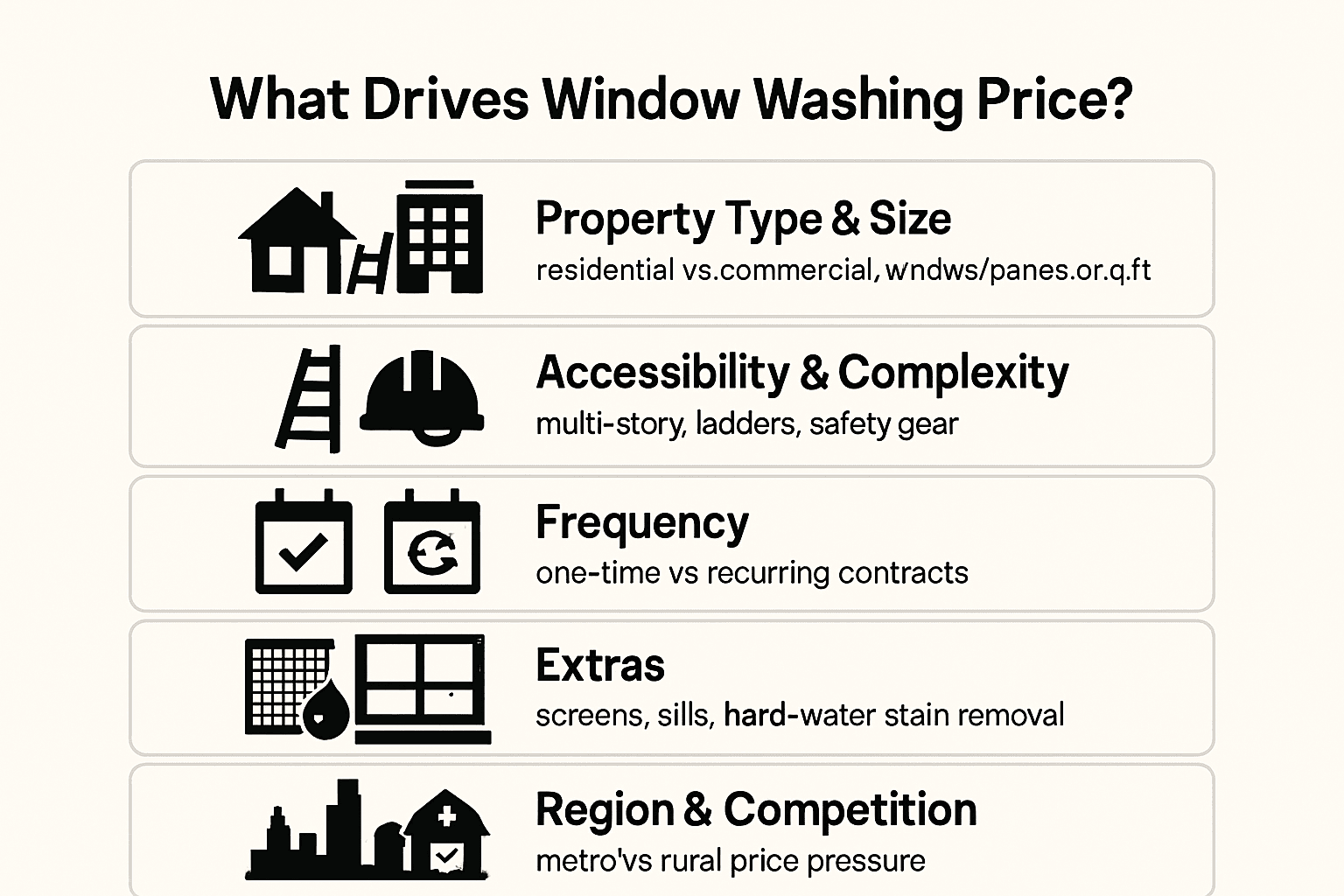
- Property Type & Size: residential vs commercial, number of windows or square footage
- Accessibility & Complexity: multi‑story structures, hard‑to‑reach windows, safety equipment
- Frequency of Service: single vs recurring contract
- Extra Services: screens, sills, hard‑water stain removal
Rates are also influenced by local competition and the economy. In areas with numerous service providers, the prices are lower, whereas in high-demand or high-income zip codes, rates tend to be higher. For example, data from IBISWorld suggests that window cleaning businesses in major metros like San Francisco or New York charge 20–35% more than smaller or rural cities due to labor costs and demand.
How to Calculate Sale Price for Window Washing (Including Quotes Best Practices and Market Research)
Step 1: Market & Competition Analysis
- Research local pricing: Call mystery shops or check out the competitors to benchmark. Depending on areas, commercial rates are generally between 0.50-2.50/ft, residential between 8-16/window or 4-8/pane.
- Competitive analysis framework: Apply the Porter Five Forces as a model to analyse the competitive threats and customer power, as well as to determine entry threats. Compare top profile competitors in terms of speed of quotations, pricing levels, level of service and reputation.
- Annual review: Keep an eye on the services and prices of the competitors; remain beyond the price bar by adding value instead of reducing prices.
- Industry reference: Reports from Grand View Research and IBISWorld can give you general trends, including growth in residential window services and pricing trends by region.
Step 2: Cost‑Plus & Value‑Based Pricing
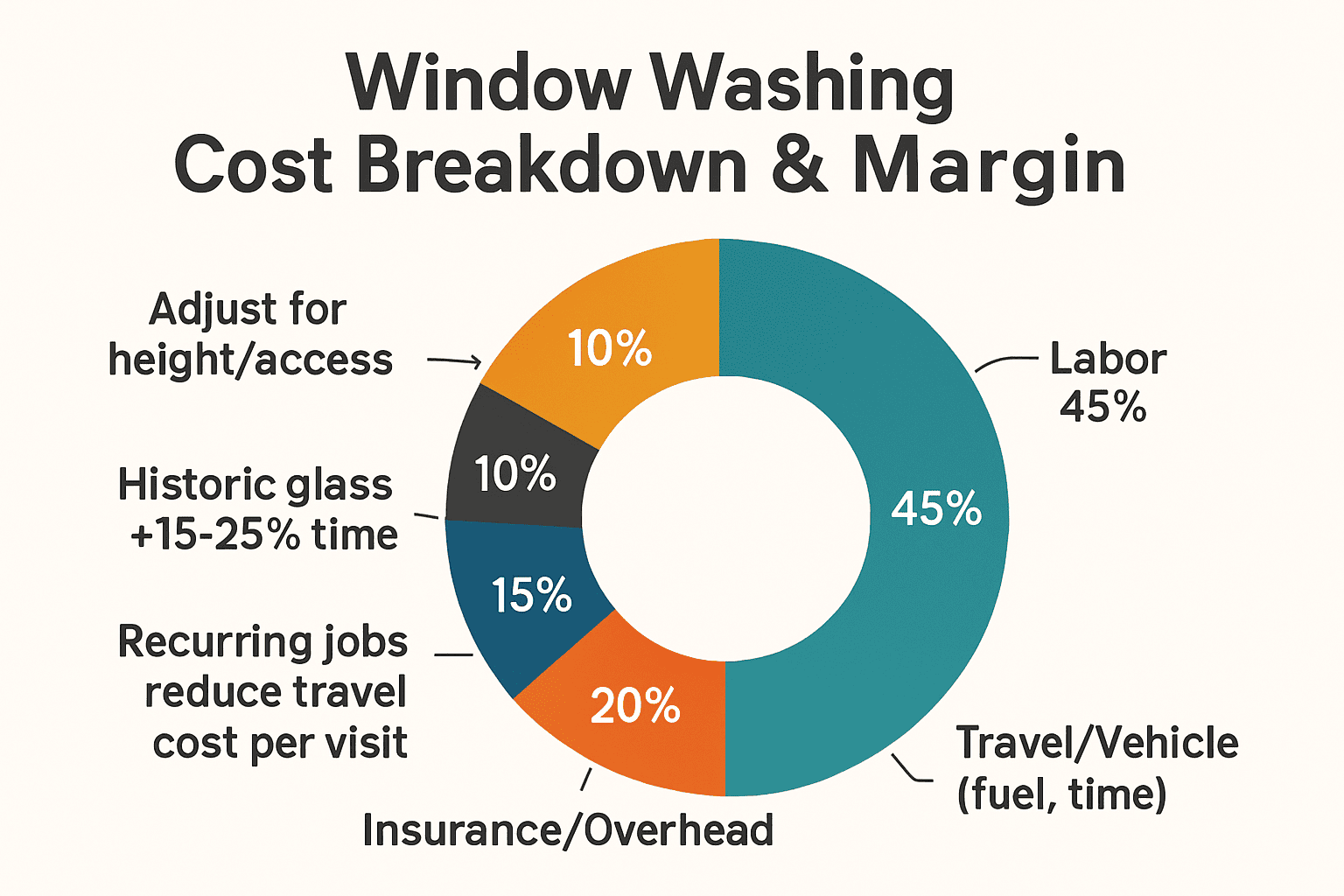
- Estimate your costs: labor per hour, equipment wear, insurance, travel, overhead.
- Add markup: typically 20–40%, adjusted by customer or job size.
- Consider special conditions: For properties that are extremely dirty, historic, or have delicate materials, factor in additional cleaning time, special equipment, or material-specific solutions. For example, historic glass windows may require lower pressure and gentler methods, increasing cost by 15–25%.
Step 3: Quoting Best Practices
- Combine your quote process with pricing calculations:
- Use professional templates or softwareList by number of windows or by square footage, what services are involved and how often.
- Account for revisions or scope changes in terms.
Example Pricing Ranges
Use these standards and adjust based on accessibility, grime level, frequency, region, and additional services. In high-income metro areas like LA or Boston, these rates may be 20–30% higher, while rural areas may fall 10–15% below.
Residential Window Cleaning Pricing Guide
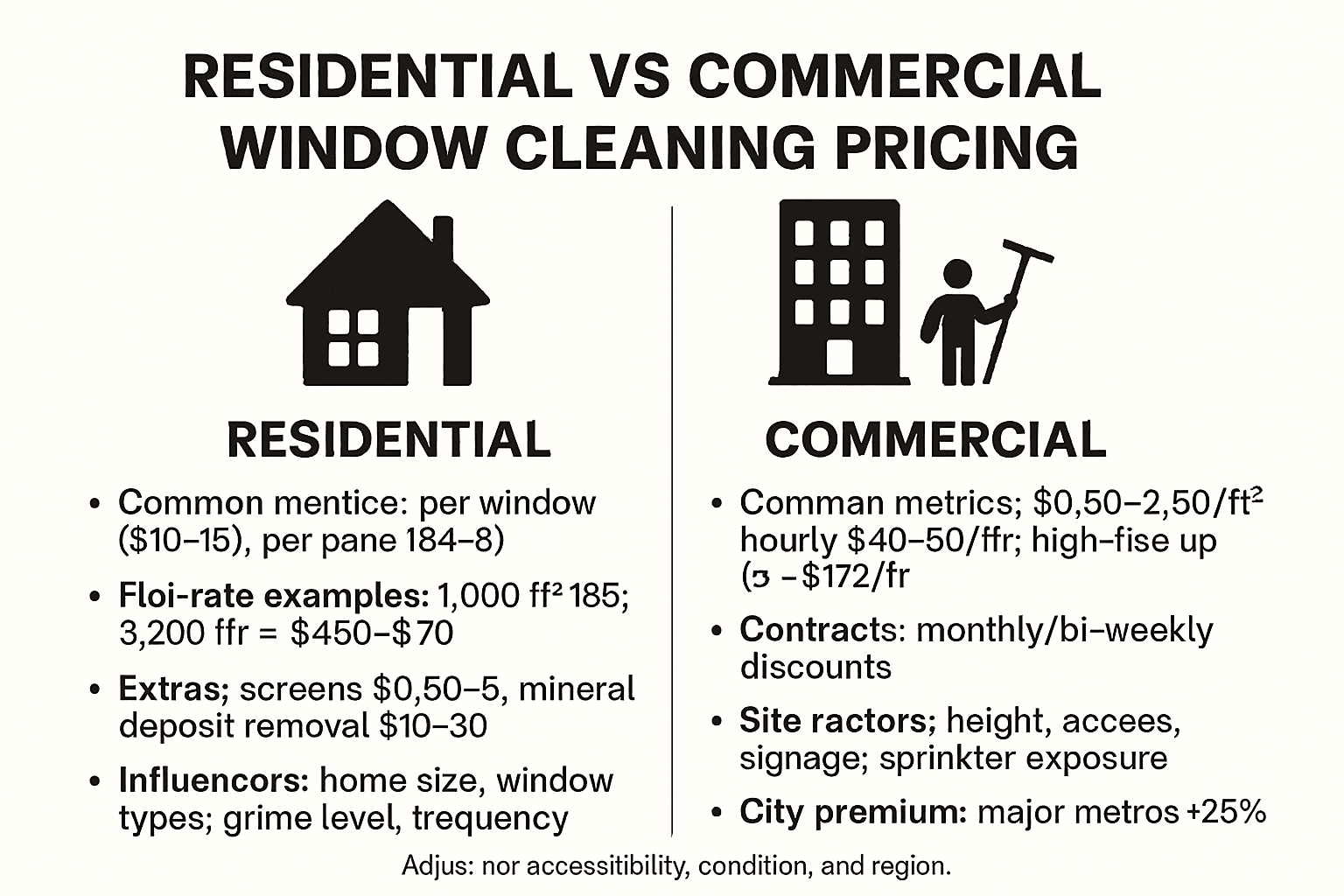
- Per‑window/per‑pane pricing: Most clients prefer these for transparency.
- Double‑hung or standard pane: ~$4/paneCasement or sliding door: ~$7/pane
- Skylight or large picture window: $12–28/window
- Flat‑rate pricing by home size: Example: 1,000 ft² ≈ $185; 3,200 ft² ≈ $450–570
- Extras: screen cleaning ($0.50–5/screen), mineral‑deposit removal ($10–30), dust removal ($1–2/window)
- Special cases: For properties with years of neglect, grime removal could require degreasers and multiple passes, expect a 20–50% markup.
How to Price Commercial Window Washing
- Square‑foot pricing: Common range $0.50–$2.50/ft², increasing with dirt, height, or difficulty.
- Hourly pricing: Typical $40–60/hr; high‑rise may reach $170/hr.
- Recurring contracts: Provide a reduction in rates or discounts on a monthly or bi-weekly basis; guarantees good consistency in workload and earnings.
- Site assessment matters: Include inaccessible windows, signage to move, sprinkler exposure, or extra cleaning required in your quote.
- Pricing note: Areas like Chicago or Seattle have higher labor costs, resulting in increased hourly rates, often $70–80/hr even for mid-size buildings.
Tools & Software That Help Price Accurately
Key functions that benefit the window washing business:
- Auto‑calculators for labor, sq ft/pane, extras, markup, and margins
- Quote builder (PDF/email) including presentation‑ready templates
- Rate tables for residential/commercial, add‑on services
Integration functions with business management software:
- Sync with CRM or scheduling platforms
- Link invoices and estimate data
- Share pricing templates among field staff
These tools reduce admin errors and create consistent client‑facing output.
Market Research & Competition Analysis Methods
- Mystery shopping: Local providers, pretending to be a customer, can call and gather quote information.
- Publicly posted pricing: Look for competitive rate guides, or aggregators.
- Porter’s Five Forces approach: Evaluate competition forces, customer bargaining, threat of substitutes, threat of new entrants and supplier bargaining. Use this to make your brand a value (quality or reliability or safety) choice and not to just compete on price.
- Benchmark analysis: Set up a table comparing competitors in term of price, speed of response, services, reputation and infrastructure.
- Industry insights: Research from IBISWorld or Statista can reveal market size, growth trends, and average service margins across the country.
FAQs About Window Cleaning Pricing
What is the cost to clean windows per hour?
Commercial jobs: typically $40–60/hr; high‑rise can range up to $170/hr.
How do I calculate a sale price for window washing?
Sum costs (labor + overhead + materials), divide by expected hours or units, then add markup. Adjust based on market positioning and client type.
Who determines window cleaning company prices in competitive markets?
Companies that conduct systematic competitor analysis, differentiate via service quality, and use value‑based pricing rather than simply matching others.
Conclusion
It is necessary to have proper pricing so that both residential and commercial services are charged appropriately. By combining market research, competitor analysis, cost-plus and value-based approaches, you can confidently determine how to price window washing jobs in a way that ensures profit, competitiveness, and client satisfaction. And when you have the right pricing tools, and integrated business software, you will be able to work on the quoting and operations step by step.
Interested in starting and developing a window cleaning business?
At Jesun, we supply window cleaners with high-quality products that give you the power to work smarter, faster, and develop with efficiency. Whether working on a residential project or commercial contracts, our industry grade resources and equipment are meant to reduce your workflow. Contact us now.




 English
  Spanish
  Russian
  Arabic