
Por Cathy Shen — Especialista en la industria de la limpieza | Actualizado el 29 de junio de 2026
El mercado mundial de fregonas de limpieza se valoró en aproximadamente $7.3 mil millones en 2025, con las fregonas planas de microfibra reclamando la mayor cuota de segmento en 34,21 TP3T y creciendo a una CAGR de 5,41 TP3T (Informe de Dataintelo sobre fregonas de limpieza manual, 2025Mientras tanto, las fregonas de algodón con hilos están perdiendo terreno de forma constante a una tasa de crecimiento anual compuesta (TCAC) del 1,81%, mientras que las fregonas de esponja mantienen una tasa de crecimiento moderada del 3,21% (TCAC). Sin embargo, la elección de la fregona adecuada depende menos de las tendencias del mercado y más del tipo de suelo, la cantidad de suciedad y los requisitos de higiene de sus instalaciones.
Si entras en cualquier armario de suministros comerciales, probablemente encontrarás una mezcla de los tres, pero la mayoría fueron elegidos por costumbre, no por datos. Esta comparación desglosa las fregonas de esponja, planas y de cuerda en rendimiento higiénico, coste, durabilidad e idoneidad de la zona. Para ayudar a los administradores de instalaciones a crear un programa de limpieza basado en datos. Cada sección incluye estudios de mercado actualizados y evidencia revisada por pares para que pueda tomar decisiones de compra basadas en datos, no en la intuición.
Conclusiones clave
- Fregonas planas de microfibra Ofrecen la mejor higiene (reducción microbiana de 95% frente a los 68% del algodón), la mayor vida útil (300-500 lavados) y el menor coste por ciclo a pesar de un precio inicial entre 25 y 50% más elevado.
- Fregonas de cuerda Siguen siendo rentables para zonas con mucha suciedad, como las cocinas de los restaurantes, pero conllevan riesgos documentados de contaminación cruzada bacteriana (P=0,0062 frente a los trapeadores planos).
- Fregonas de esponja Su uso se limita a la limpieza superficial; en aplicaciones comerciales se requiere un reemplazo semanal debido a la retención microbiana de hasta 7,4 Log UFC/g.
- Despliegue basado en zonas — Utilizar diferentes tipos de fregona para diferentes áreas de las instalaciones — ofrece mejores resultados que cualquier estrategia de usar una sola fregona.
Tabla de contenido
Palanca¿Cuáles son los tres tipos de fregonas y cómo funcionan?
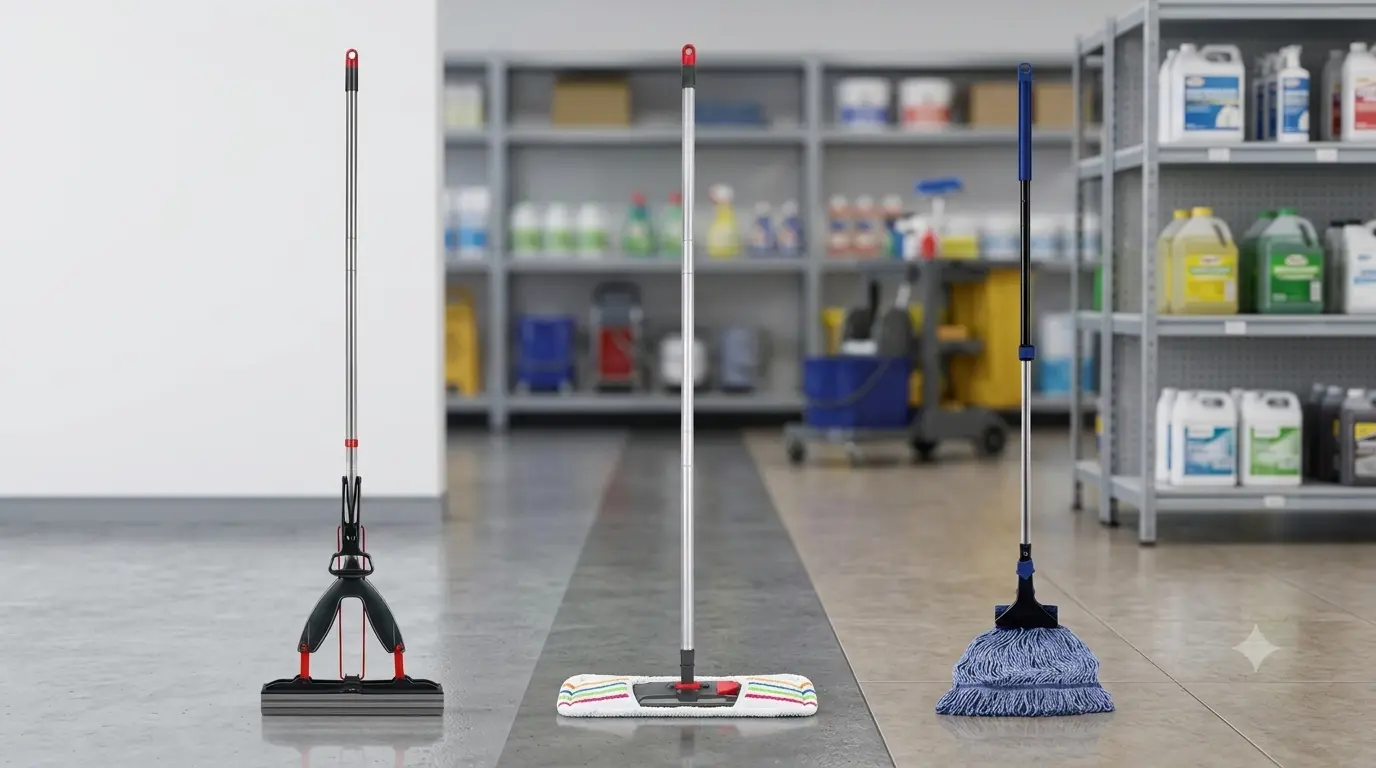
Tres sistemas de fregado predominan en la limpieza comercial: fregonas planas de microfibra (Cuota de mercado del 34,21 TP3T, ~1 TP4T2,50B), fregonas de hilo de algodón (Participación de 26,4%, ~$1,93B), y trapeadores de esponja (Participación de 22,8%, ~$1,66B) (Informe de Dataintelo sobre fregonas de limpieza manual, 2025Cada uno emplea un mecanismo de limpieza fundamentalmente diferente con características de rendimiento distintas.
Fregonas de esponja Utilizan un cabezal de espuma de PVA (alcohol polivinílico) o celulosa que absorbe el agua por capilaridad. Son ideales para superficies lisas y suciedad ligera, como la limpieza de manchas en baños o retoques en áreas pequeñas. Un mecanismo de escurrido mecánico expulsa el agua, pero la estructura de la espuma atrapa las partículas en lugar de liberarlas durante el lavado.
Fregonas planas de microfibra Consta de una almohadilla rectangular hecha de fibras divididas de poliéster-poliamida. Estas fibras divididas crean una carga estática que atrae el polvo y una estructura capilar abierta que levanta y atrapa líquidos y suciedad. Un cabezal de fregona plano suele cubrir entre 250 y 300 pies cuadrados por almohadilla y se puede lavar. 300-500 veces antes de que sea necesario reemplazarlo (Informe de la EPA sobre el uso de fregonas de microfibra; Panel de expertos de CleanLink, 2020).
Fregonas de hilo de algodón Utilice hilo de algodón retorcido o en bucle sujeto a una diadema de metal o plástico. Son la opción más absorbente (capacidad de agua de 16 a 24 onzas por cabezal) y son excelentes para recoger grandes cantidades de suciedad. Sin embargo, la estructura del hilo retorcido retiene bacterias y residuos en lo profundo de las fibras, y las fregonas básicas de algodón de extremo cortado se degradan después de solo 15-30 lavados (Sello Verde, 2025El algodón con extremos en bucle dura más, entre 50 y 75 lavados, pero presenta el mismo riesgo de retención bacteriana.
Tendencia destacada: las fregonas de hilo son en descenso a una tasa de crecimiento anual compuesta (CAGR) de 1,81 TP3T mientras que las fregonas planas crecen a 5,4% CAGR (Dataintelo, 2025Esta diferencia de 7,2 puntos porcentuales refleja un cambio fundamental en el comportamiento de compra comercial hacia la tecnología de microfibra, impulsado por los estándares de higiene y los cálculos del costo total de propiedad.
¿Qué tipo de fregona ofrece el mejor rendimiento higiénico?
Un estudio revisado por pares por Li et al. (2023) publicado en Consejos para el control de infecciones descubrieron que las fregonas de hilo de algodón quedaron significativamente más viable S. aureus en los pisos que las fregonas planas con almohadillas de microfibra lavables o desechables (P=0,0062)Diversey / Li et al., 2023Esta diferencia fue estadísticamente significativa independientemente de la solución de limpieza utilizada, lo que significa que la construcción de la fregona en sí, y no el producto químico, fue el factor determinante.
El punto de referencia fundamental proviene de Rutala, Gergen y Weber (2007) en el Revista estadounidense de control de infecciones: fregonas de microfibra con detergente logrado Reducción microbiana 95% en comparación con las fregonas de hilo de algodón en 68% (PubMed, PMID 17980233). Esta diferencia de 27 puntos porcentuales es citada frecuentemente por ambos Sello Verde y la EPA en sus estándares de limpieza.
Las fregonas de esponja presentan una preocupación higiénica distinta. Un estudio de 2026 en Microorganismos (14[3]:552) examinar las esponjas de limpieza en una unidad de oncología pediátrica encontró que Las esponjas estaban dominadas por Moraxellaceae y Pseudomonadaceae, con Acinetobacter especies presentes como patógenos oportunistas (Microorganismos, 2026Las investigaciones sobre seguridad alimentaria también han documentado que los materiales esponjosos favorecen el crecimiento bacteriano y son difíciles de desinfectar entre usos. En los establecimientos comerciales, esto significa que los cabezales de fregona de esponja deben considerarse consumibles de corta duración, no herramientas reutilizables.
¿Cómo se comparan los costos entre los tres sistemas?
Costo de las fregonas planas de microfibra 25-50% más adelante ($12-35 por cabeza) que las fregonas de esponja ($5-15) o de hilo ($3-8), pero entregan el menor costo por ciclo debido a su vida útil de 300-500 lavados en comparación con los cabezales de esponja que necesitan reemplazo comercial semanal y el hilo de algodón que se degrada después de 15-30 lavados (Informe de la EPA sobre el uso de fregonas de microfibra; Sello Verde, 2025).
| Factor de costo | Trapeador de esponja | Microfibra plana | Hilo de algodón |
|---|---|---|---|
| Coste inicial por persona | $5-15 | $12-35 | $3-8 |
| Vida útil (lavados) | ~150 (pero se reemplazan semanalmente) | 300-500 | 15-30 |
| Cabezas anuales necesarias (uso diario) | ~52 | ~2-4 | ~12-24 |
| Coste por ciclo de lavado | $0.07-0.10 | $0.03-0.07 | $0.10-0.27 |
| Coste anual por unidad (marco de fregona individual) | $260-780 | $24-140 | $36-192 |
| Eficiencia laboral (por 300 m²) | ~40 min | ~25 min | ~45 min |
| Punto de equilibrio del TCO frente al algodón | N/A — nunca más barato | ~150 lavados | Base |
Fuentes: Estudio de caso de la EPA y la UC Davis sobre microfibras; Anuncio publicitario de Rubbermaid Australia, 2026; La estación de limpieza, 2025.
La brecha en la eficiencia laboral es particularmente reveladora: los sistemas de fregona plana pueden limpiar 300 metros cuadrados en aproximadamente 25 minutos en comparación con los 45 minutos de las fregonas de hilo (Anuncio de Rubbermaid, 2026). Dado que La mano de obra representa entre el 85% y el 90% de los costos de limpieza comercial. (Sello Verde, 2025), una reducción de 44% en el tiempo de fregado impacta directamente en los resultados finales. El estudio de caso del Centro Médico UC Davis documentó Ahorro de costes durante la vida útil de 60% y ahorro de mano de obra de 20% por día. después de cambiar de fregonas convencionales de bucle a microfibra (garantía de >500 lavados) (Región 9 de la EPA, 2002).
Una advertencia importante: la microfibra es No apto para entornos con grasa en el servicio de alimentos. — Los aceites apelmazan las fibras divididas y las vuelven ineficaces. En las cocinas de los restaurantes, las fregonas de hilo de algodón o de mezcla sintética siguen siendo la opción práctica (Panel de expertos de CleanLink, 2020).
¿Cuántos ciclos de lavado dura cada tipo de fregona?
Los cabezales de fregona plana de microfibra resisten 300-500 ciclos de lavado en uso comercial, con sistemas de fregona plana que alcanzan 500-900 lavados dependiendo de las condiciones de atención (Panel de expertos de CleanLink, 2020). Técnicamente, los cabezales de fregona de esponja soportan entre 150 y 180 ciclos de lavado mecánico, pero en la práctica las instalaciones comerciales deben reemplazarlos. semanalmente debido a preocupaciones de higiene. Las fregonas de hilo de algodón duran solo 15-30 lavados antes de que se deshilache, se acumule olor y se pierda la capacidad de absorción (Sello Verde, 2025).
| Tipo de fregona | Ciclos de lavado | Vida útil comercial (tiempo) | Se necesitan cabezas anuales |
|---|---|---|---|
| Almohadilla plana de microfibra | 300-500 | 3-6 meses (uso moderado) | ~2-4 |
| Microfibra plana (sistemas de alta gama) | 500-900 | 6-12 meses | ~1-2 |
| Cabezal de fregona de esponja | ~150 (pero se reemplazan semanalmente) | 1-2 semanas | ~26-52 |
| Cordón de algodón con extremo en bucle | 50-75 | 1-2 meses | ~6-12 |
| Cordón de algodón con el extremo cortado | 7-9 (descartar) | De un solo uso / semanal | ~52-365 |
Fuentes: Panel de expertos de CleanLink, 2020 (500-900 ciclos de fregado plano); Informe de la EPA sobre microfibras; Dataintelo, 2025.
La brecha entre 2-4 reemplazos anuales (fregona plana) y 26-52 (esponja) es el principal factor que influye en las diferencias de costos totales. A $12-35 por almohadilla plana frente a $5-15 por cabezal de esponja, a primera vista parece que las esponjas son más rentables. Pero si multiplicamos por los reemplazos anuales, la situación cambia: las fregonas planas cuestan $24-140 al año frente a $260-780 para las fregonas de esponja que utilizan el mismo armazón. Las fregonas de esponja cuestan entre 3 y 5 veces más al año a pesar de costar la mitad por unidad..
¿Qué sistema de fregado es el más adecuado para cada zona comercial?
Ningún tipo de fregona destaca en todas las zonas comerciales. El enfoque óptimo es despliegue basado en zonas: utilice fregonas planas de microfibra en el sector sanitario y hotelero para la higiene, fregonas de cuerda en el sector de la restauración y en zonas industriales para la suciedad incrustada, y fregonas de esponja solo para la limpieza puntual de baños con frecuencia y con programas de reemplazo frecuentes.
| Zona | Recomendado | Por qué |
|---|---|---|
| Habitaciones para pacientes en el sector sanitario | microfibra plana | Máxima eliminación de bacterias; zonas codificadas por colores; lavable según los CDC (CDC, 2024) |
| Aislamiento hospitalario | compresa plana desechable | El uso individual por habitación elimina el riesgo de contaminación cruzada. |
| Habitaciones de hotel para huéspedes | microfibra plana | De secado rápido, ergonómico (más ligero), con código de colores por zonas (estándar AHLA). |
| Cocina de restaurante | Fregona de cuerdas (sintética) | Resistencia a la grasa y al aceite; alta capacidad de absorción; esteras de microfibra libres de aceites. |
| pasillos escolares | Cuerda o plana | Sensible al costo: cuerda para presupuesto, plano para higiene |
| Comercio minorista / oficina | microfibra plana | Secado rápido; bajo riesgo de resbalones durante el horario de apertura. |
| Limpieza de manchas en los baños | Esponja (edición limitada) | Absorción rápida y específica, pero reemplácelo con frecuencia; No apto para baños sanitarios. |
| Industrial/servicios públicos | Fregona de cuerdas (de alta resistencia) | Máxima capacidad de absorción; rentable para zonas con mucha suciedad y poca higiene. |
Fuentes: Procedimientos de limpieza ambiental de los CDC, 2024; Li et al. / Diversey, 2023; Panel de expertos de CleanLink, 2020.
La única línea que no debes cruzar: Las fregonas de esponja nunca deben utilizarse en entornos sanitarios.. El estudio del microbioma hospitalario de 2026 aisló directamente bacterias patógenas de esponjas de limpieza en entornos clínicos (Microorganismos, 2026). Para el sector sanitario, las directrices de limpieza ambiental de los CDC recomiendan fregonas planas de microfibra con una separación de zonas adecuada.
Para obtener una visión más detallada de la programación de reemplazos y la planificación de inventario específica para cada zona, consulte nuestra Guía de reemplazo de cabezales de fregona comerciales.
¿Qué recomiendan los expertos para las fregonas comerciales?
Consenso de la industria desde el Panel de expertos de CleanLink (2020) y el estudio revisado por pares de Diversey recomienda encarecidamente las fregonas planas de microfibra como opción predeterminada para la mayoría de las instalaciones comerciales. El panel de CleanLink, compuesto por cinco fabricantes y especialistas de la industria, destacó la ventaja del “coste de uso” de sistemas de fregona plana, con panelistas que reportan entre 500 y 900 ciclos de lavado y beneficios ergonómicos que “Reducir drásticamente las bajas por enfermedad, el dolor de espalda y los contratiempos derivados de lesiones”. entre el personal de limpieza (CleanLink, 2020).
El consenso del panel para cada tipo de fregona se desglosa de la siguiente manera:
- Fregonas planas de microfibra — La mejor opción integral para la mayoría de las zonas comerciales. Máxima higiene, mayor vida útil y menor coste por ciclo. Recomendado para centros sanitarios, hostelería, oficinas y comercios.
- Fregonas de hilo de algodón — Ideal para áreas de servicio con suciedad pesada y entornos propensos a la grasa donde la microfibra no es adecuada. Mayor riesgo de contaminación cruzada bacteriana, confirmado por evidencia revisada por pares.
- Fregonas de esponja — Uso limitado: limpieza puntual de baños con programas de reemplazo frecuentes. No se recomienda para entornos donde la higiene sea fundamental.
JESUN fabrica los tres tipos de fregonas y los comentarios de nuestros clientes comerciales confirman esta misma jerarquía: las fregonas planas de microfibra representan una creciente mayoría de pedidos repetidos una vez que las instalaciones completen un ciclo de adquisición completo con los tres sistemas.
Veredicto: ¿Qué sistema de fregado gana en su categoría?
| Categoría | Ganador | Por qué |
|---|---|---|
| Higiene / eliminación de bacterias | Microfibra plana ✓ | Reducción de 95% frente a 68% (algodón), ventaja de P=0,0062 confirmada |
| Coste por ciclo de lavado | Microfibra plana ✓ | $0.03-0.07 frente a $0.10-0.27 (algodón), $0.07-0.10 (esponja) |
| Durabilidad / ciclos de lavado | Microfibra plana ✓ | 300-500 (hasta 900 premium) frente a 15-30 (algodón), ~150 (esponja) |
| Ergonomía / eficiencia laboral | Microfibra plana ✓ | 25 min/300 m² frente a 45 min (hilo); menor peso por pasada de la fregona. |
| Capacidad para suelos pesados | Fregona de cuerdas ✓ | Capacidad de agua de 16 a 24 onzas; resistente a la grasa; ideal para el servicio de alimentos. |
| Versatilidad para la limpieza de manchas | Fregona de esponja ✓ | Conveniente para áreas pequeñas; pero requiere un reemplazo frecuente. |
| En general (la mayoría de las zonas comerciales) | Microfibra plana ✓ | El mejor equilibrio entre higiene, coste, durabilidad y ergonomía. |
En resumen: Para la mayoría de los establecimientos comerciales, las fregonas planas de microfibra ofrecen la mejor combinación de higiene, rentabilidad y durabilidad. Las fregonas de hilo siguen siendo esenciales para el servicio de alimentos y las zonas con mucha suciedad. Las fregonas de esponja tienen una función limitada en la limpieza puntual de baños, pero conllevan riesgos para la higiene que las descalifican para el sector sanitario y la hostelería.
La línea de productos de JESUN incluye los tres sistemas. Descubra nuestros sistemas de fregado comerciales. Para obtener recomendaciones específicas de la zona, o visite nuestra página Página sobre el cuidado de suelos mojados para soluciones de fregonas planas de microfibra de grado sanitario.
Preguntas frecuentes
¿Qué tipo de fregona elimina la mayor cantidad de bacterias?
Fregonas planas de microfibra: Reducción microbiana 95% en comparación con las fregonas de hilo de algodón a 68% (Rutala y otros, Revista estadounidense de control de infecciones, 2007). Un estudio de Diversey (Li et al., 2023) descubrieron que las fregonas de hilo de algodón dejan significativamente más viables S. aureus en los suelos que las fregonas planas con almohadillas desechables (P=0,0062). Las fregonas de esponja conllevan riesgos para la higiene: un estudio de 2026 Microorganismos Un estudio reveló que bacterias patógenas colonizaban las esponjas de limpieza de los hospitales.
¿Con qué frecuencia se deben reemplazar los cabezales de las fregonas de esponja comerciales?
Cada Mínimo de 1 a 2 semanas En el ámbito comercial, diversos estudios confirman que los materiales esponjosos favorecen el crecimiento bacteriano y dificultan su desinfección entre usos. En comparación, las almohadillas planas de microfibra duran entre 300 y 500 lavados, mientras que las fregonas de algodón requieren reemplazo cada 15 a 30 lavados. Con 52 reemplazos al año, frente a los 2 a 4 de las almohadillas planas, las fregonas de esponja resultan más caras anualmente a pesar de su menor precio unitario.
¿Cuál es el coste total de propiedad de las fregonas planas frente a las de tiras?
Costo de las fregonas planas de microfibra 25-50% más adelante ($12-35 por cabeza) pero el último 10-20 veces más largo que el hilo de algodón, alcanzando el punto de equilibrio del TCO en aproximadamente 150 ciclos de lavadoEn entornos hospitalarios, la microfibra ha demostrado Ahorro de costes durante la vida útil del 60% y un ahorro diario de mano de obra de 20% en comparación con las fregonas de bucle convencionales (Estudio de caso de la EPA y la UC Davis).
¿Se pueden utilizar fregonas de esponja en el sector sanitario?
No recomendado. Un estudio del microbioma hospitalario de 2026 (Microorganismos, 14(3):552) encontraron bacterias patógenas, entre ellas Acinetobacter y Moraxellaceae Esponjas de limpieza colonizadoras en una unidad de oncología pediátrica. El personal sanitario debe utilizar fregonas planas de microfibra con almohadillas desechables o lavables por Directrices de limpieza ambiental de los CDC.
¿Qué tipo de fregona es la mejor para los suelos de zonas de servicio de alimentos?
Fregonas de hilo — específicamente mezclas sintéticas — son la opción práctica para las cocinas de los restaurantes. Los trapeadores de microfibra pierden eficacia cuando las fibras separadas se apelmazan por la grasa y los aceites. Los trapeadores de esponja carecen de la capacidad de suciedad incrustada necesaria para las áreas propensas a la grasa (Panel de expertos de CleanLink, 2020Para las zonas de comedor al aire libre con poca suciedad, pueden funcionar las fregonas planas de microfibra con un lavado frecuente.
Conclusión
Elegir la fregona comercial adecuada no se trata de encontrar un único tipo "mejor", sino de adaptarla a cada zona. Los datos demuestran sistemáticamente que las fregonas planas de microfibra son la opción más versátil y rentable para la mayoría de las aplicaciones comerciales, mientras que las fregonas de hilo son fundamentales en entornos con mucha suciedad y las fregonas de esponja requieren un uso seguro y preciso.
Conclusiones clave:
- Fregonas planas de microfibra Son la mejor opción integral para la mayoría de las zonas comerciales: reducción bacteriana 95%, 300-500 lavados, el menor coste por ciclo y ventajas ergonómicas.
- Fregonas de cuerda Son excelentes en zonas con suelos pesados (servicios de alimentación, industria), pero conllevan riesgos documentados de contaminación cruzada bacteriana y no deben utilizarse en el sector sanitario.
- Fregonas de esponja Su uso se limita a la limpieza superficial de baños, con reemplazo semanal; nunca deben ingresar a entornos sanitarios.
- Despliegue basado en zonas —una combinación de tipos adaptados a las áreas específicas de las instalaciones— es más eficaz que cualquier estrategia de un solo tipo de fregona.
JESUN, como el mayor fabricante mundial de herramientas de limpieza desde 1986, diseña sistemas de fregado comerciales Para los tres tipos incluidos en esta comparativa, ya sea que necesite sistemas de microfibra plana para el sector sanitario, fregonas de hilo para la restauración o una combinación específica para cada zona en un campus con varios edificios, podemos ofrecerle la herramienta adecuada para cada tarea.
Referencias
- Li, X. et al. "¿Todos los métodos manuales de fregado de suelos ofrecen los mismos resultados de higiene?" Consejos para el control de infecciones, 20 de marzo de 2023. https://infectioncontrol.tips/2023/03/20/do-all-manual-floor-mopping-methods-give-the-same-hygiene-outcomes/
- “Entre la esponja y el grifo: comunidades bacterianas en puntos críticos de higiene hospitalaria que suelen pasarse por alto.” Microorganismos, 14(3):552, 28 de febrero de 2026. DOI: 10.3390/microorganisms14030552. PubMed PMID 41900312
- Rutala, WA, Gergen, MF y Weber, DJ “Evaluación microbiológica de fregonas de microfibra para la desinfección de superficies.” Revista estadounidense de control de infecciones, 35(9):569-573, 2007. PubMed PMID 17980233
- Agencia de Protección Ambiental de los Estados Unidos. «Informe sobre el uso de fregonas de microfibra» (estudio de caso del Centro Médico de la UC Davis). Archivado. https://19january2017snapshot.epa.gov/www3/region9/waste/p2/projects/hospital/mops.pdf
- Centros para el Control y la Prevención de Enfermedades. “Procedimientos de limpieza ambiental”. Infecciones asociadas a la atención médica según los CDC, 2024. https://www.cdc.gov/healthcare-associated-infections/hcp/cleaning-global/procedures.html
- Sello Verde. “Estándar medioambiental para productos de limpieza”. Sello Verde.org, 2025. https://greenseal.org
- CleanLink / Decisiones sobre limpieza de instalaciones. “Expertos analizan las opciones de fregado”. CleanLink.com, 2020. https://www.cleanlink.com/hs/article/Experts-Analyze-Mopping-Options–26045
- Dataintelo. “Informe de investigación de mercado sobre fregonas de limpieza manual 2033.” Dataintelo.com, 2025. https://dataintelo.com/report/manual-cleaning-mops-market
- Rubbermaid Commercial (Australia). “Fregona plana frente a fregona de cuerdas: prevención de lesiones y limpieza más rápida en el sector de la hostelería”. 2026. https://www.rubbermaidcommercial.com.au/…/flat-mop-vs-string-mop-injury-prevention
- Solenis / Diversey. «Un nuevo estudio demuestra que los diferentes materiales para fregar suelos ofrecen resultados de higiene distintos». Comunicado de prensa, 2023. https://www.solenis.com/en/resources/news-releases/2023/…