
أهم النقاط
- Bristle brushes scrub harder; silicone brushes dry faster and survive bleach and acid descalers without degrading.
- Nylon tufts splay within 3–6 months, while silicone fins hold their shape for 12–24 months, which changes the real cost of ownership.
- Silicone is non-porous, so it traps less moisture and residue between uses — the main reason independent testers rate it as more sanitary.
- Neither material removes hard-water scale on its own. Heavy mineral deposits need a descaler before either brush can work.
- Most homes are best served by both: a stiff bristle head for the monthly deep clean and a silicone head for daily passes.
مقدمة
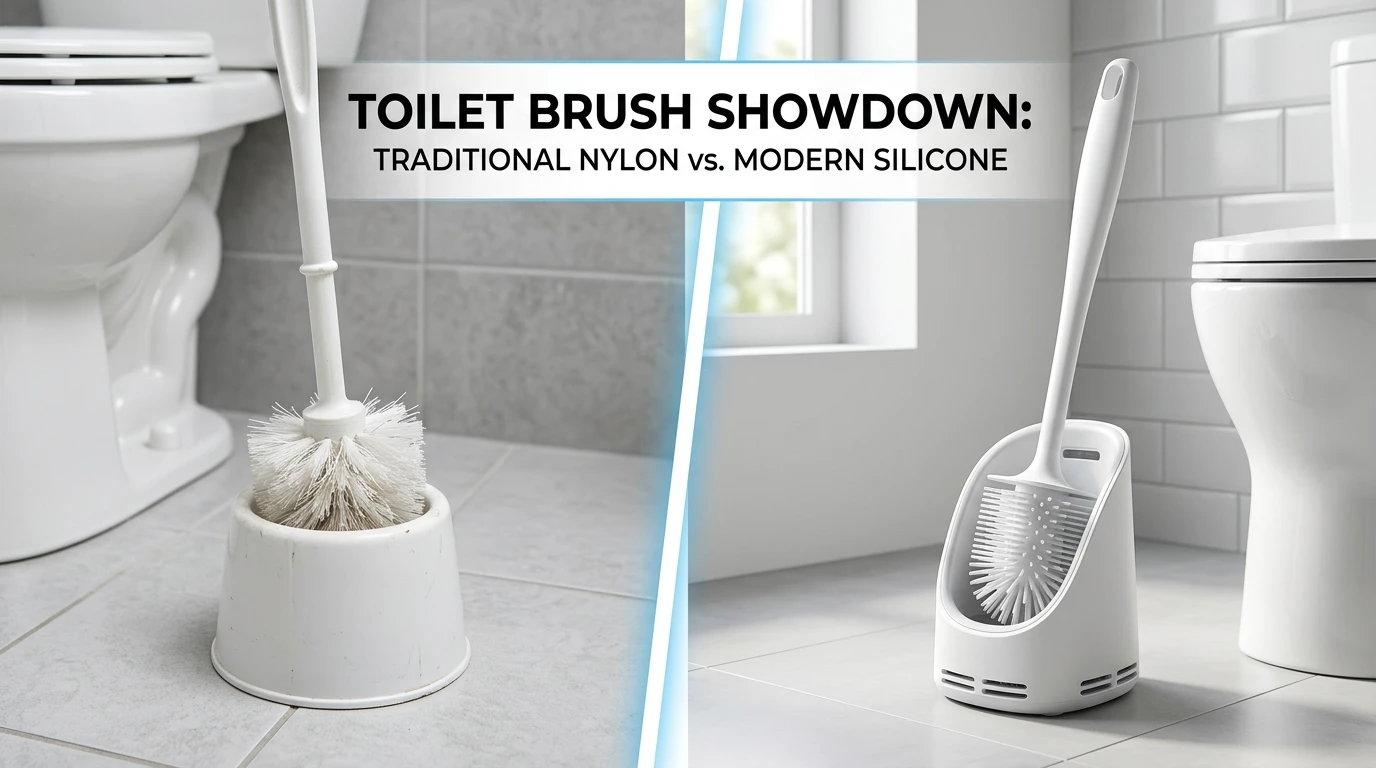
Traditional vs silicone toilet brushes is the most common comparison in the category, and most articles settle it with a preference rather than a test. The honest version is that the two designs fail in opposite ways. A traditional brush with stiff nylon or polypropylene tufts removes scale and rust staining faster than anything else you can buy, but the tufts splay within a few months and then stop reaching the water line. A silicone brush never develops that problem, because it has no tufts to splay, yet it also never had the aggressiveness to strip heavy mineral deposits in the first place. Neither failure is fatal, and both are entirely predictable. The full range of head materials sits in types of toilet brushes, and the wear timelines that decide when either design should be retired are in when to replace a cleaning brush.
What makes the comparison worth doing properly is that the two brushes are not competing for the same job. For example, a household that descales monthly and cleans daily needs a tool that survives bleach and dries fast, which points firmly at silicone. A household that cleans a neglected rental property once a quarter needs raw scrubbing power, which points at bristles. Consequently, the useful question is not which material is better in the abstract but which failure mode you can live with. This guide compares the two on hygiene, scrubbing power, durability, chemical compatibility and total cost, then gives a decision rule you can apply in a minute.
We manufacture both types, so we have no interest in steering you toward one. Notably, our own testing has found that the two designs complement each other better than either one replaces the other, and that most buyers who try to pick a single winner end up owning both within a year anyway. In addition, we found that the cost argument usually settles the decision faster than the hygiene argument does, because the numbers are easier to check.
Traditional vs Silicone Toilet Brushes: The Head-to-Head Comparison
The table below covers the seven factors that decide the comparison. Notably, only two of them favour bristles outright, which is why silicone has taken so much share in the last decade despite the higher unit price.
| عامل | Traditional bristle brush | Silicone brush |
|---|---|---|
| Head construction | Extruded nylon, PP or TPR tufts anchored in a plastic head | Moulded fins, teeth or a flexible paddle, usually one piece |
| Scrubbing power | Highest; bites into scale, rust and dried residue | Moderate; effective on daily soil, weak on mineral scale |
| Drying speed | Slow; water sits between tufts for hours | Fast; a non-porous surface sheds water in minutes |
| صحة | Fair; debris and moisture lodge between tufts | Excellent; nothing to trap residue |
| Shape retention | Splays in 3–6 months of regular use | Holds shape for 12–24 months |
| Chemical resistance | Degrades with repeated bleach and acid descalers | Largely inert to both |
| Cost of ownership | Low purchase price, frequent replacement | Higher purchase price, fewer replacements |
Hygiene: Why Material Beats Shape
Hygiene is where the two designs separate most clearly, and the reason is porosity rather than shape. Nylon tufts create hundreds of narrow gaps where water, waste and organic residue collect, and those gaps are exactly where a rinse cannot reach. Silicone has no gaps at all, so the head sheds water and rinses clean in seconds. Independent testing has reached the same conclusion: silicone heads tend to be more sanitary than plastic-bristled ones because they dry quickly and trap less moisture and bacteria (BHG, 2026). For a tool stored in a humid bathroom inches from a toilet, that difference compounds every single day.
The microbiology behind it is well established. A 1975 study of household toilets found that bacteria and viruses seeded into a bowl persisted after flushing and continued to elute from the porcelain over subsequent flushes, which means a brush is repeatedly exposed to a residual microbial load (Gerba et al., 1975). In that environment, the material that dries fastest and holds the least residue has a clear advantage. Consequently, public health guidance that separates routine cleaning from disinfection is easier to follow with a silicone head, because routine cleaning actually returns the tool to a clean state rather than leaving a damp reservoir behind (CDC, 2025).
Two caveats keep this fair. First, a silicone brush stored in a closed, unventilated cup will still stay wet, because the holder can defeat the material’s best property. Second, a bristle brush that is rinsed after every use and stored in open air can be kept sanitary for months. In our experience, the holder and the drying routine matter more than the material, though the material makes the routine far easier to keep. Similarly, a silicone head that is rinsed and shaken out will be dry before the next use, while a bristle head in the same routine is still damp hours later.
Scrubbing Power: Where Bristles Still Win
If a bowl has visible scale, rust staining or dried residue, a stiff bristle head is simply faster. The tufts bite into the deposit the way a scrub pad does, and they flex into the curves of a bowl that a rigid paddle cannot follow. For instance, a hard-water ring that has been building for a season will usually come off in one pass with a nylon brush and several passes with a silicone one. That is not a defect in the silicone design. It is the trade-off that makes the material hygienic in the first place, because soft flexible fins cannot apply the same concentrated pressure at the contact point.
Two practical points follow from that. First, mineral scale is a chemistry problem before it is a scrubbing problem, and an acid descaler left to work for a few minutes will do more than any brush. Second, scrubbing harder with either tool is counterproductive, because excess pressure splays nylon tufts faster and can scratch a delicate glaze. Meanwhile, the silicone head keeps working on the everyday soil that makes up most cleaning sessions: light film, splash marks and the fine deposit that builds between deep cleans. For most households, that is ninety percent of the job. In our experience, the deep clean is a monthly event and the daily pass is what actually keeps the bowl presentable, which is the argument for owning both.

JESUN Silicone Toilet Brush and Holder Set (B8)
PP and TPR head in a matching holder, 36.5×9.8×4.3 cm, 0.25 kg. The silicone-side option: nothing to splay, and it rinses clean in seconds.
Durability and Cost of Ownership

The purchase price comparison is misleading, because the two brushes do not last the same amount of time. A nylon bristle head used twice a week in a hard-water bathroom typically shows visible splaying and discolouration within three to six months. A silicone head in the same bathroom holds its shape and flexibility for twelve to twenty-four months. Over two years, that is four bristle heads against one or two silicone heads, which usually closes the price gap entirely. In addition, a silicone head does not absorb the smell of the cleaners used with it, so it stays neutral between cleans.
| Two-year view (one bathroom, twice-weekly use) | Traditional bristle | Silicone |
|---|---|---|
| Heads needed | 4–6 | 1–2 |
| Typical head price band | قليل | Low to mid |
| Scrubbing performance at month 6 | Noticeably reduced | Unchanged |
| Risk of shedding into the bowl | Increases with age | Very low |
There is one more durability factor that neither material controls, and that is the handle. A cracked or loosened joint ends the life of the whole tool regardless of how well the head has held up, so buying a set with a replaceable head is the cheapest way to keep the two-year cost down. Importantly, replaceable heads also let you keep a bristle head and a silicone head on the same handle, which is the configuration we recommend to most households.
Chemical Compatibility: Bleach and Acid Descalers
This is the least discussed factor and the one that decides the comparison for anyone who cleans aggressively. Concentrated chlorine bleach, hydrochloric-acid descalers and enzymatic cleaners degrade nylon fibres over time, causing brittleness, discolouration and shedding. Silicone is largely inert to all three, so a silicone head used with the same products keeps its flexibility while a nylon head is quietly being consumed. Consequently, a household that descales monthly will replace nylon heads far more often than the calendar suggests, and the failure will look like poor quality rather than chemical attack.
If you prefer bristles for their scrubbing power, the practical mitigation is sequence rather than substitution. Apply the descaler first, let it work, flush, and then use the bristle brush to remove what has softened, rinsing the head thoroughly afterwards. That approach keeps the acid off the tufts for most of the cleaning cycle and extends the head’s life considerably. Similarly, avoid leaving any brush standing in a bucket of diluted bleach between uses, because prolonged immersion is what accelerates the damage in both materials. As a result, the cheapest way to extend the life of a bristle head is to change the order of the job rather than the product you buy.
JESUN Hard Bristle Double-sided Toilet Brush (KLB02)
Stiff double-sided head in PP and TPR, holder 12×21 cm and brush 37.5×8 cm, 0.26 kg. The bristle-side option when the bowl has visible scale or rust.
Which One Should You Buy?
Apply the decision in this order, and the answer usually takes less than a minute.
- Choose silicone if you clean weekly, use bleach or acid descalers, want the brush to dry fast, or share a bathroom where hygiene matters.
- Choose bristles if the bowl has visible scale or rust, if you clean a property intermittently, or if you need to remove dried residue in one pass.
- Choose TPR rubber as a middle option if you want blades that rinse clean but still apply more pressure than silicone fins.
- Buy both if you want one tool for daily passes and one for the monthly deep clean, sharing a single handle where the design allows.
- Check the holder before either, because an unventilated cup will undo the hygiene advantage of silicone within weeks.
Whichever you pick, treat the holder as part of the purchase rather than an accessory. A ventilated or wall-mounted holder lets the head dry between uses, which is the single cheapest improvement available in either design. In our experience, buyers who fix the holder first are satisfied with whichever brush they choose, while buyers who keep a closed cup end up disappointed with both.
الأسئلة الشائعة
Are silicone toilet brushes better than traditional bristle brushes?
For hygiene and durability, yes: silicone is non-porous, dries fast and resists bleach and acid descalers, so it holds its shape for 12 to 24 months. For raw scrubbing power against heavy scale, traditional bristle brushes are still faster. Most homes benefit from having both.
Do silicone toilet brushes clean as well as bristle brushes?
They clean everyday soil just as effectively. They are weaker on hard-water scale, rust staining and dried residue, because soft fins cannot apply the same concentrated pressure as stiff tufts. An acid descaler handles that part of the job better than any brush.
How long does each type last?
A nylon or polypropylene bristle head typically lasts three to six months before the tufts splay. A silicone head lasts 12 to 24 months. Bleach and acid descalers shorten a bristle head’s life considerably but have little effect on silicone.
Is silicone really more hygienic, or is that marketing?
It is a material property rather than a claim. Silicone has no gaps between tufts, so residue and moisture cannot lodge inside the head, and independent testing has found silicone heads more sanitary than plastic-bristled ones for exactly that reason. Storage still matters: a silicone brush in a closed cup will stay wet.
Can I use bleach with a silicone toilet brush?
Yes. Silicone is largely inert to chlorine bleach, hydrochloric-acid descalers and enzymatic cleaners, all of which degrade nylon over repeated exposure. Rinse the head after use and let it dry, and avoid leaving it standing in a bucket of diluted bleach.
Do rimless toilets need a different brush?
They benefit from one. A rimless bowl has a flat inner wall and an exposed outlet, so a flexible silicone paddle or a TPR blade follows the surface better than a round bristle head. Traditional bristle brushes still work, but they tend to miss the corners where residue collects.
Need both in one order?
We supply silicone, TPR and stiff bristle toilet brush heads, ventilated holders and wall-mounted sets, with OEM or ODM packaging from low MOQs.
Request Wholesale Pricing →خاتمة
Traditional and silicone toilet brushes are not rivals so much as specialists. Bristles win on scrubbing power and cost per unit, and they remain the right tool for a scaled or neglected bowl. Silicone wins on hygiene, drying speed, chemical resistance and total cost over two years, which is why it has become the default recommendation for routine bathroom maintenance. Neither removes mineral scale on its own, and neither performs well in a closed, unventilated holder. That said, if you want a single answer and your bowl is already clean, silicone is the safer default.
We build both types, along with TPR and disposable variants, and we are happy to help you work out which combination suits your market.
مراجع
- Better Homes & Gardens — “The 5 Best Toilet Brushes of 2026, Tested for Scrubbing.” bhg.com/best-toilet-brushes-6891820
- Gerba CP, Wallis C, Melnick JL — “Microbiological Hazards of Household Toilets: Droplet Production and the Fate of Residual Organisms,” Applied Microbiology 30(2):229–237, 1975. journals.asm.org/doi/10.1128/am.30.2.229-237.1975
- US Centers for Disease Control and Prevention — “When and How to Clean and Disinfect Your Home.” cdc.gov/hygiene/about/when-and-how-to-clean-and-disinfect-your-home.html
- University of Illinois Extension — “A guide to keeping your sponges, dish rags and scrub brushes clean.” extension.illinois.edu/blogs/simply-nutritious-quick-and-delicious
This guide was written by the JESUN Cleaning Tools Team and reviewed by our product engineering group. You can read more about us أو contact our team with questions about brush materials.
Continue Learning
- ما وراء الوعاء: تنظيف فرشاة المرحاض بعمق — how to sanitise the tool itself, not just the toilet.
- فرشاة المرحاض للاستخدام مرة واحدة مقابل عصا كلوركس لتنظيف المرحاض — the single-use alternative, compared head to head.
- Toilet brush catalog — silicone, TPR, bristle and disposable sets.


 Arabic
 English
 Spanish
 Russian