

Основные выводы
- Five squeegee types cover most jobs: window, shower, floor, car and water-collect or spray models.
- The blade material decides the result: rubber grips smooth glass and tile, silicone lasts longer and resists hardening, foam and EVA conform to uneven floors.
- Width trades speed against control — a narrow blade for glass, a wide blade for corridors and wet rooms.
- A squeegee only works when the surface is wet and the blade edge is clean, because a nick or a grit particle leaves a streak on every pass.
- Replace the blade when it hardens, nicks or leaves a thin trail of water, rather than replacing the whole tool.
Введение
The main types of squeegees are separated by the surface they dry rather than by the shape of the handle. A window squeegee has a narrow rubber blade on a short handle, sized so you can pull a clean line down a pane. A shower squeegee is wider and lighter, designed to be used in seconds after every shower. A floor squeegee has a broad foam, EVA or rubber blade on a long handle and pushes standing water to a drain. A car squeegee has a soft, often chamois-backed edge for curved glass and paint. A water-collect or spray squeegee adds a channel or a reservoir so the dirty water is captured instead of running down the glass. These are the wet end of the уход за влажным полом range, and the dry end is covered in how to clean broom bristles.
What all five share is a single principle: a squeegee removes liquid by moving it, not by absorbing it. That makes the blade edge the entire tool. A clean, sharp, flat edge pushes a sheet of water ahead of it and leaves nothing behind. A hardened or nicked edge lets water slip underneath, which is why a squeegee that used to be perfect starts leaving a thin trail across the middle of a pane or a floor. Consequently, most squeegee complaints are blade complaints, and the fix is usually a replacement blade rather than a new tool. We manufacture squeegees across all five categories, so the comparisons below draw on our own product testing.
This guide covers each type, the four blade materials, how to choose width and handle, and the technique that produces a streak-free pass. In addition, it covers cleaning and replacement so the blade keeps working long after the novelty of a new squeegee has worn off. In our experience, a blade that is rinsed and hung after every use outlasts an identical one left standing on a wet sill by several months.
The Main Types of Squeegees at a Glance
The table below sorts the category by surface and blade. In contrast to a general-purpose wiper, a task-specific squeegee costs less and performs better, because blade width and material are matched to one job rather than compromised across several. Notably, the same blade that clears a shower screen in two strokes is awkward on a narrow pane. The width bands below are the ranges we build to as a manufacturer, so treat them as typical rather than as a rule, and match the blade to the space you are clearing rather than to the surface area.
| Тип | Blade | Typical width | Лучше всего подходит для | Handle |
|---|---|---|---|---|
| Window squeegee | Rubber or silicone, sharp edge | 150–350 mm | Glass panes, mirrors, partitions | Short, sometimes telescopic |
| Shower squeegee | Silicone or rubber, soft edge | 200–300 mm | Shower screens, tiles, bath surrounds | Short with a hook or suction mount |
| Швабра для пола | Foam, EVA or heavy rubber | 450–900 mm | Wet rooms, kitchens, garages, corridors | Long, often telescopic |
| Car squeegee | Soft rubber or chamois edge | 150–300 mm | Windscreens, bodywork, mirrors | Short with a grip |
| Water-collect / spray | Blade plus a collection channel | 250–450 mm | Dirty glass, high windows, dusty panes | Telescopic with a reservoir |
Why a Squeegee Leaves Water Behind
Before the type-by-type detail, here is the diagnosis that solves most squeegee complaints. A blade removes water by pushing it, so anything that breaks the contact between blade and surface leaves a trail: a nicked edge, a trapped grit particle, too little water to lubricate the pass, or too much downward pressure bowing the blade so its ends lift. None of those are product faults, and all four are fixable in under a minute. Use the table, then read the section for your surface.
| Symptom | Usual cause | Fix |
|---|---|---|
| A thin line of water down the middle | A nick in the blade edge | Replace the blade; nicks cannot be dressed out at home |
| Streaks that move with each pass | Grit trapped on the blade | Wipe the blade on a cloth between every stroke |
| The blade skips and chatters | Too little water, or a blade that has hardened with age | Wet the surface properly; if it still chatters, the blade has hardened and needs replacing |
| Water escapes from both ends of the blade | Too much pressure, bowing the blade off the surface | Reduce pressure and let the edge do the work |
| Water left along grout lines or uneven tile | A smooth blade riding over the joints | Switch to a moss rubber blade, which is built for grouted floors |
Window Squeegees

A window squeegee is the most precise tool in the category, and the one where technique matters most. Its blade is narrow and sharp-edged so it can be pulled in controlled strokes down a pane, and its handle is short so your hand stays close to the glass. The goal is a single continuous pass that pushes a bead of water to the edge without leaving a line behind. For a large pane, professionals work in overlapping vertical strokes and wipe the blade between each one, which is why a professional window cleaning kit includes a scrim or a cloth as standard.
Two variations are worth knowing. A squeegee with a swivel or pivoting head lets you angle the blade for a horizontal pull on a tall window, which reduces the number of strokes. A squeegee combined with a scrubber, usually on the reverse of the same head, lets you wet and agitate the glass before you pull, which is the correct order for a dusty exterior pane. In our testing, the biggest single improvement to a window-cleaning result was not the blade material but wiping the blade between strokes, since a blade carrying grit drags that grit down the glass and leaves a scratch line. Consequently, a cloth for wiping the blade is part of the tool rather than an accessory.
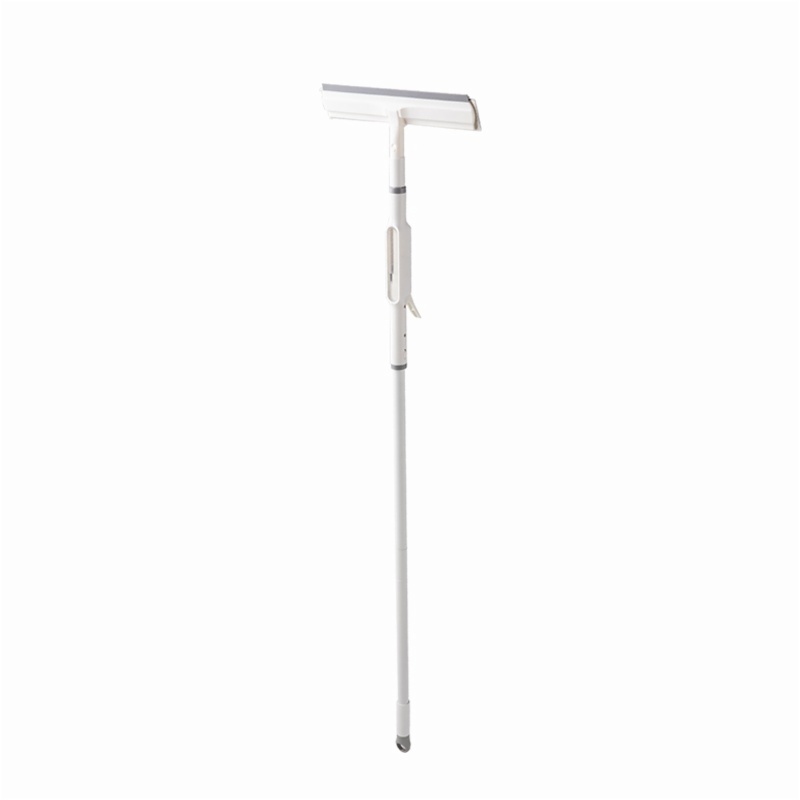
JESUN 3 in 1 Window Squeegee (FP-53)
Rubber blade with a PP and aluminium frame, 130×30×6.5 cm, 0.467 kg. Combines a scrubber, a squeegee and a microfiber pad, which is the wet-then-pull order a dusty pane needs.
Shower and Bathroom Squeegees
A shower squeegee exists to prevent a problem rather than to fix one. Pulling water off a shower screen and tiled wall after every use removes the droplets that would otherwise dry in place and deposit limescale, which is what turns glass cloudy over months. That makes it a two-minute habit with a large payoff. Consequently, the best shower squeegee is the one you will actually pick up: light, short, and stored where you can reach it from inside the shower rather than in a cupboard. A suction mount or a hook on the screen solves that.
Blade material matters here more than in a window squeegee, because the blade is used wet every day. Rubber grips smooth glass well but hardens over time and eventually chatters, while silicone keeps its flexibility far longer and resists the limescale and bleach it will meet. In addition, a soft edge is less likely to damage a coated or frosted screen. Meanwhile, the blade width should match the screen rather than the wall: a 250 mm blade clears a standard shower screen in two strokes, while a wider one is awkward in a confined space. In our experience, a silicone-bladed shower squeegee lasts several times longer than a rubber one in daily use. Similarly, a suction mount that keeps the tool inside the shower is what makes the daily habit stick.
Floor Squeegees and Water Removal
A floor squeegee is a safety tool as much as a cleaning tool, because standing water on a hard floor is a slip risk. Its blade is wide and usually made from foam, EVA or heavy rubber, mounted on a long handle so you can push water ahead of you while standing upright. In a wet room, a commercial kitchen, a garage or a bathroom after a leak, it is the fastest way to move a large volume of water towards a drain or a doorway. Public health guidance treats drying as a central step in cleaning, because a wet surface continues to support microbial growth while it stays damp (CDC, 2025).
Blade material changes the character of the tool. Rubber blades grip smooth tile and push water efficiently, but they harden with age and eventually chatter across the surface. Blade shape matters just as much on a floor: a straight blade pushes water in one direction and is the right choice for a corridor or a flat wet room, while a curved blade gathers water toward the centre as you pull and is easier to steer around a garage or a large open slab. In addition, moss rubber is the third floor blade to know about — a coarse, tear-resistant material built for grouted and uneven commercial tile, where a smooth rubber blade would skip across the joints and leave water behind. Foam and EVA blades conform to slightly uneven floors and are more forgiving on concrete, though they wear faster under heavy use. Width then trades speed against manoeuvrability: a 600 mm blade clears a corridor quickly but will not fit between fixtures. Notably, a floor squeegee blade must be kept clean, because a blade carrying grit will scratch a polished floor with every pass. Rinse it after use and store it hanging rather than resting on the blade edge. As a result, the blade keeps a straight edge and continues to clear water in a single pass.

JESUN Multifunction Magic Broom (FG-11)
TPR blade on a 128×30 cm PP, TPR and iron body, 0.4 kg. Sweeps and pushes water in one pass — the floor-side tool for wet rooms, garages and commercial kitchens.
Car and Glass Squeegees
A car squeegee is a specialist tool because vehicle glass is curved and paintwork is unforgiving. The blade has to be soft enough to follow a windscreen curve without lifting at the edges, and clean enough that it never drags grit across a painted surface. That is why the best car squeegees use a soft rubber or chamois edge rather than a stiff blade, and why they should be rinsed before every use. For drying a whole vehicle, a dedicated water blade is faster than a cloth, but only if the bodywork has been washed first, since a blade used on a dusty panel simply grinds the dust into the paint.
Interior glass is a separate case. A small squeegee with a short handle reaches the inside of a windscreen and the rear window, where a cloth tends to leave lint and streaks. For example, a narrow 150 mm blade with a swivel head cleans the inside of a windscreen in three passes, while a wide blade catches on the dashboard and the mirror housing. Meanwhile, the blade should be stored dry and away from heat, because a rubber blade left on a dashboard in summer will harden within a season. In our testing, storage made a bigger difference to car squeegee life than the material did. In addition, a soft chamois edge is safer than a stiff blade on curved glass and painted panels.
Water-Collect and Spray Squeegees
A water-collect squeegee adds a channel behind the blade so the dirty water is captured instead of running down the glass and onto the sill. That design matters most on high or external windows, where a run of dirty water leaves streaks that are harder to remove than the original grime. A spray squeegee goes one step further and adds a reservoir and a trigger, so you can wet the glass and pull it dry with the same tool. Together they remove the need for a separate spray bottle and a cloth on simple jobs, which is why they are popular for conservatory roofs, shopfronts and any window you cannot reach easily.
The trade-off is complexity. A collection channel needs emptying and rinsing, and the reservoir needs cleaning, or the tool starts delivering dirty water onto clean glass. In addition, a heavier head on a telescopic pole is harder to control at full extension, so the blade can lift away from the surface at the end of a long reach. Consequently, these models suit occasional large jobs better than daily use. Notably, a water-collect squeegee used properly can cut the time spent on a set of high windows roughly in half, because it eliminates the follow-up pass with a cloth. However, a collection channel that is not rinsed will simply deliver dirty water onto the next pane.
Blade Materials Compared
Blade material decides how the squeegee behaves on the surface, how long it lasts and what it can safely touch. The table below covers the four common options.
| Blade material | Grip on smooth surfaces | Прочность | Best use | Weakness |
|---|---|---|---|---|
| Rubber | Отличный | Moderate; hardens with age | Windows, mirrors, smooth tile | Chatters once it hardens |
| Silicone | Very good | High; resists hardening | Showers, daily wet use, bleach and descalers | Slightly less bite on heavy water |
| Foam | Good on uneven floors | Low; wears quickly | Concrete and rough wet rooms | Rips under heavy debris |
| EVA | Good; conforms well | Умеренный | Large wet areas, garages, patios | Less precise on glass |
| Moss rubber | Very good on rough and grouted floors | High; resists tearing | Uneven tile, quarry tile, grouted commercial floors | Too coarse for glass or smooth vinyl |
In our experience, the practical combination for a household is rubber for window and mirror work, silicone for the shower, and EVA or foam for floors. That keeps the precise blade away from abrasive floor debris and keeps the floor blade wide enough to clear water quickly, which is the division of labour these materials were designed for. In our testing, keeping the precise blade away from floor debris was the single biggest factor in how long each blade lasted.
Choosing Width, Handle and Edge
Three specifications decide whether a squeegee suits your job, and none of them are complicated.
- Blade width: 150–200 mm for interior glass, 250–300 mm for shower screens and standard windows, 450–900 mm for floors.
- Handle type: short and rigid for precision, telescopic for reach, threaded socket if you want to swap between heads.
- Edge profile: a straight sharp edge for glass, a softer or slightly rounded edge for coated and frosted screens.
- Head fitting: a swivel head for tall panes, a fixed head for floors where control matters more than angle.
- Blade replacement: confirm spare blades are available, because the blade is the part that wears.
If you buy only three squeegees, buy a narrow rubber window squeegee, a silicone shower squeegee and a wide EVA floor blade on a long handle. Those cover precision glass, daily wet use and standing water, which are the three jobs a single squeegee cannot do well. Then add a water-collect model only if you regularly clean high or external windows, because its extra complexity earns its place only on those jobs.
Getting a Streak-Free Pass
Technique decides the result more than the tool, and the rules are consistent across every squeegee type. Work on a wet surface, because a blade dragged across dry glass or dry tile will skip and scratch. Start at the top and pull downward in overlapping strokes, wiping the blade on a cloth between each pass so grit does not carry down the surface. Keep the blade at a slight angle rather than flat, and finish each stroke at the edge of the surface rather than in the middle, so the water has somewhere to go. For a floor, push rather than pull, and work towards a drain in overlapping lanes.
Three mistakes cause most streaks. First, using too little water, which makes the blade chatter and leaves a line where it skipped. Second, leaving the blade dirty, which turns a single grit particle into a scratch that runs the length of the pane. Third, pressing too hard, which bows the blade and lifts its ends off the surface, letting water escape underneath. In our experience, light pressure with a clean blade and plenty of water produces a perfect pass, while heavy pressure produces streaks no matter how good the squeegee is. For example, a blade pulled with light pressure across a well-wet pane leaves no line at all, while the same blade pressed hard lifts at both ends.
Cleaning and Replacing Squeegee Blades
Blades need almost no maintenance, but the little they need is essential. Rinse the blade after every use, wipe it dry, and store the tool hanging or standing so the edge does not rest on a surface and deform. Once a week, wash the blade and the frame in warm soapy water, and check the edge for nicks by running a fingernail along it. For bathroom squeegees, a periodic descale removes the mineral film that builds on the blade and causes chattering. Meanwhile, keep the tool away from direct heat, since rubber hardens quickly on a sunny sill or a car dashboard.
Replacement is straightforward: the blade is finished when it hardens, develops a nick, or leaves a thin trail of water behind an otherwise clean pass. In practice that is every six to twelve months for a rubber blade in daily shower use, longer for silicone, and every few months for a foam floor blade in commercial use. An NSF International study reported by Consumer Reports found coliform bacteria on 75% of sampled household sponges and rags, and extension services make the same point about cleaning tools that are not washed and dried between uses (Consumer Reports, 2025). A squeegee blade that is left wet and loaded with floor water is no exception, so rinse and hang it rather than leaving it on the floor. That said, the blade is the only part that matters, so a spare blade is cheaper than a spare tool.
Часто задаваемые вопросы
What are the main types of squeegees?
Five types cover most jobs: window squeegees for precision glass work, shower squeegees for daily wet surfaces, floor squeegees for pushing standing water, car squeegees for curved vehicle glass, and water-collect or spray models that capture dirty water instead of letting it run.
Is silicone or rubber better for a squeegee blade?
Rubber grips smooth glass slightly better and is the traditional choice for window work. Silicone keeps its flexibility far longer, resists hardening, and tolerates bleach and acid descalers, which makes it the better choice for a shower squeegee used daily. Rubber hardens with age and eventually chatters.
Why does my squeegee leave streaks?
Three causes, in order of likelihood: a dirty or nicked blade carrying grit, too little water on the surface so the blade skips, or too much pressure bowing the blade so its ends lift. Rinse the blade, wet the surface properly, wipe the blade between strokes and use light pressure.
How wide should a floor squeegee be?
Match the width to the space rather than the floor size. A 450 to 600 mm blade clears a corridor or wet room quickly, while a wider blade is faster in open areas but will not fit between fixtures. For confined bathrooms, a 300 to 450 mm blade is easier to control.
How often should a squeegee blade be replaced?
Every six to twelve months for a rubber blade used daily in a shower, longer for silicone, and every few months for a foam floor blade in commercial use. Replace it when it hardens, develops a nick, or leaves a thin trail of water behind an otherwise clean pass.
Sourcing squeegees for your range?
We manufacture window, shower, floor, car and water-collect squeegees in rubber, silicone, foam and EVA, with telescopic and fixed handles, and OEM or ODM support from low MOQs.
Request Wholesale Pricing →Заключение
Squeegees are separated by the surface they dry, and the blade is what decides the result. A narrow rubber blade is right for glass and mirrors, a silicone blade suits a shower used daily, a wide EVA or foam blade clears standing water from a floor, and a soft-edged blade belongs on a car. Water-collect and spray models add a channel or a reservoir for high and external windows, at the cost of extra cleaning. Across all five, the same rules apply: work wet, keep the blade clean, wipe it between strokes, use light pressure and replace it the moment it hardens or nicks. That said, the cheapest improvement to any squeegee is a clean edge rather than a new tool.
We build squeegees in every blade material and width, with telescopic and fixed-handle options, and we are happy to help you match a range to your market.
Ссылки
- US Centers for Disease Control and Prevention — “When and How to Clean and Disinfect Your Home.” cdc.gov/hygiene/about/when-and-how-to-clean-and-disinfect-your-home.html
- Westwood JCN, Mitchell MA, Legacé S — “Hospital Sanitation: the Massive Bacterial Contamination of the Wet Mop,” Applied Microbiology 21(4):693–697, 1971. journals.asm.org/doi/10.1128/am.21.4.693-697.1971
- Consumer Reports — “Household Cleaning Tools: How to Clean and When to Replace.” consumerreports.org/home-garden/cleaning/how-to-clean-and-when-to-replace-household-cleaning-tools
- University of Illinois Extension — “A guide to keeping your sponges, dish rags and scrub brushes clean.” extension.illinois.edu/blogs/simply-nutritious-quick-and-delicious
This guide was written by the JESUN Cleaning Tools Team and reviewed by our product engineering group. You can read more about us или contact our team with questions about squeegee blade specifications.
Continue Learning
- Как выбрать оконный скребок — the window-specific buyer guide.
- Silicone vs Rubber Squeegee Blades — the blade material question in more depth.
- Floor squeegee catalog — rubber, foam and EVA blades with long handles.
- Shower squeegee catalog — silicone blades for daily wet use.





 Russian
 English
 Spanish
 Arabic