
Основные выводы
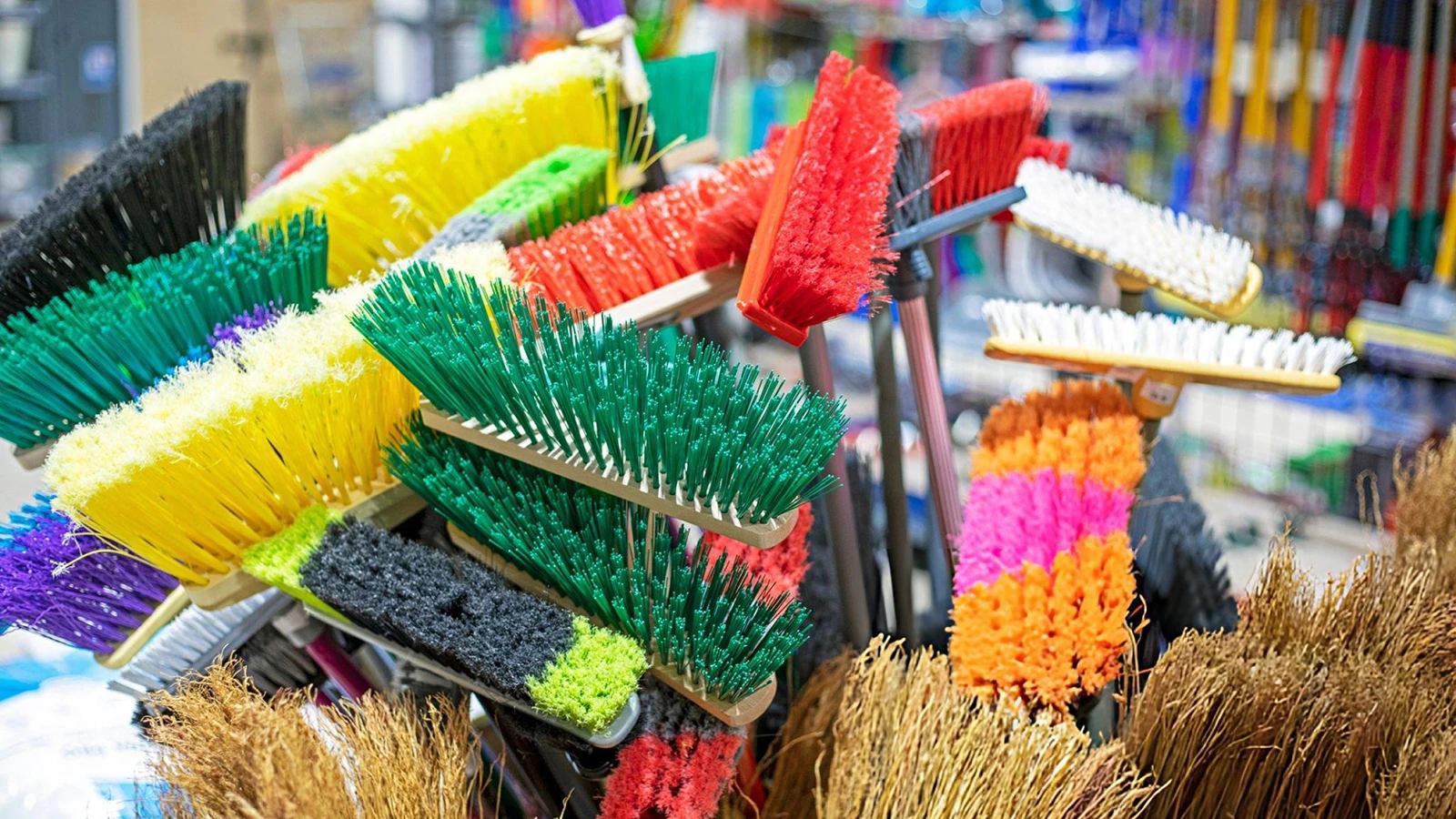
- Floor brushes fall into four working groups: scrubbing brushes, push brooms, floor squeegees for water removal, and detail brushes for grout and edges.
- Bristle stiffness and handle length decide the tool far more than brand — a soft brush on a hard floor does nothing, and a stiff brush on vinyl leaves scratches.
- Squeegees remove standing water faster than any brush, which matters for slip safety as well as for drying time.
- Floor brushes should be rinsed and hung to dry after every use, because a brush stored wet spreads contamination across the whole floor.
- Replace scrub brushes every 6–12 months, and sooner once the bristle tips shorten enough to stop contacting the surface.
Введение
Floor brushes are usually described by their bristles, but the useful way to sort them is by what they do to the floor. Scrubbing brushes apply pressure and abrasion to lift dried soil. Push brooms move loose debris across a wide area. Squeegees push standing water into a channel or a drain. Detail brushes work the narrow lines where a floor meets a wall, a tile meets a grout line, or a machine meets its base. Each group solves a different physical problem, and no single tool covers all four well. If you are sorting brushes by shape rather than by floor, types of scrub brushes takes that axis, and the kitchen equivalents sit in kitchen cleaning brushes. For example, a stiff deck brush will move a puddle around without ever removing it, while a squeegee will leave dried soil exactly where it was.
One scope note before the detail: this guide covers hand tools — the brush you hold, push or pull. It does not cover the rotary brush decks that fit a walk-behind or ride-on floor scrubbing machine. Those are a separate purchase with their own sizing rules (disc, cylindrical or oscillating decks, and pads rather than bristles on smooth floors), and a buyer choosing a machine deck is answering a different question from a buyer choosing a deck brush. If you are sourcing machine decks, ask us separately and we will point you at the right specification.
What makes floor tools different from a kitchen brush is scale and consequence. A floor brush covers square metres rather than square centimetres, so its handle length and head width change how long a job takes. Its condition also has safety implications, because a wet floor left to dry slowly is a slip risk in any building, and a brush stored wet can redistribute contamination across an entire room. Research on floor cleaning has shown how easily that happens: a study of hospital sanitation found that wet mops stored between uses were the source of widespread bacterial contamination on floors, and that drying and correct storage broke the cycle (Westwood et al., 1971).
This guide covers each group of floor brushes, the handle and bristle choices that matter, and how to match a tool to a floor type without damaging it. In addition, it covers the drying and replacement habits that keep a floor brush effective. Notably, we manufacture all four groups, so the comparisons below draw on our own product testing. In addition, we tested each group on tile, concrete and vinyl flooring before writing the guidance that follows.
The Four Working Groups at a Glance
The table below is the fastest way to work out which floor tool you are missing. In contrast to a general cleaning kit, a floor care set usually needs at least three of the four groups, because scrubbing, sweeping and drying are separate operations. Notably, the four groups overlap least in the tools they require, which is why a single purchase rarely covers a whole floor.
| Group | Typical head | Job it does | Floor types | Handle |
|---|---|---|---|---|
| Scrubbing brush | Stiff bristles, flat or angled block | Lifts dried soil and stains | Tile, concrete, stone, garage floors | Short or long, often with a swivel |
| метла | Wide bristle band, soft to stiff | Moves loose debris across large areas | Warehouse, workshop, patio, driveway | Long, two-handed or threaded |
| Швабра для пола | Single rubber, foam or EVA blade | Pushes standing water to a drain | Tile, epoxy, concrete, wet rooms | Long, sometimes telescopic |
| Detail brush | Narrow head, stiff tufts or a pointed tip | Cleans grout lines and edges | Tile, grout, skirting, machine bases | Short, hand-held |
Scrubbing and Deck Brushes

A scrubbing brush is built for pressure. Its head is a solid block with stiff bristles set close together, so the force you apply travels into the surface rather than spreading across soft tufts. That is what lifts dried food, mud, oil film and mineral staining from tile, concrete and stone. For a garage floor, a patio or a commercial kitchen, this is the tool that does the actual cleaning, and everything else in the set supports it. The longer the handle, the more leverage you get, which matters when the job takes twenty minutes rather than two. For example, a swivel head lets you scrub in both directions without lifting the brush off the floor. In our experience, the swivel is the single feature that shortens a large scrubbing job the most.
The risk is surface damage, and it is easy to cause. A stiff brush used on vinyl, laminate or a polished stone finish will leave fine scratches that dull the surface over time. Consequently, match stiffness to the floor rather than to the stain: use soft or medium bristles on resilient flooring, and reserve the stiffest heads for concrete, unglazed tile and stone. In our testing, a stiff nylon head on a vinyl plank left visible scuffing after a single aggressive pass, while the same head on a concrete floor did nothing but clean. Backing material matters too, because a wooden or plastic block distributes pressure evenly, while a thin backing flexes and concentrates force at the middle of the head.
JESUN Multifunction Floor Scrubber Brush (FSZ044)
Stiff PP bristle block on an iron handle, 0.45 kg, with a head that keeps pressure even across the floor. Built for concrete, stone and unglazed tile rather than resilient sheet flooring.
Push Brooms and Sweeping Brushes
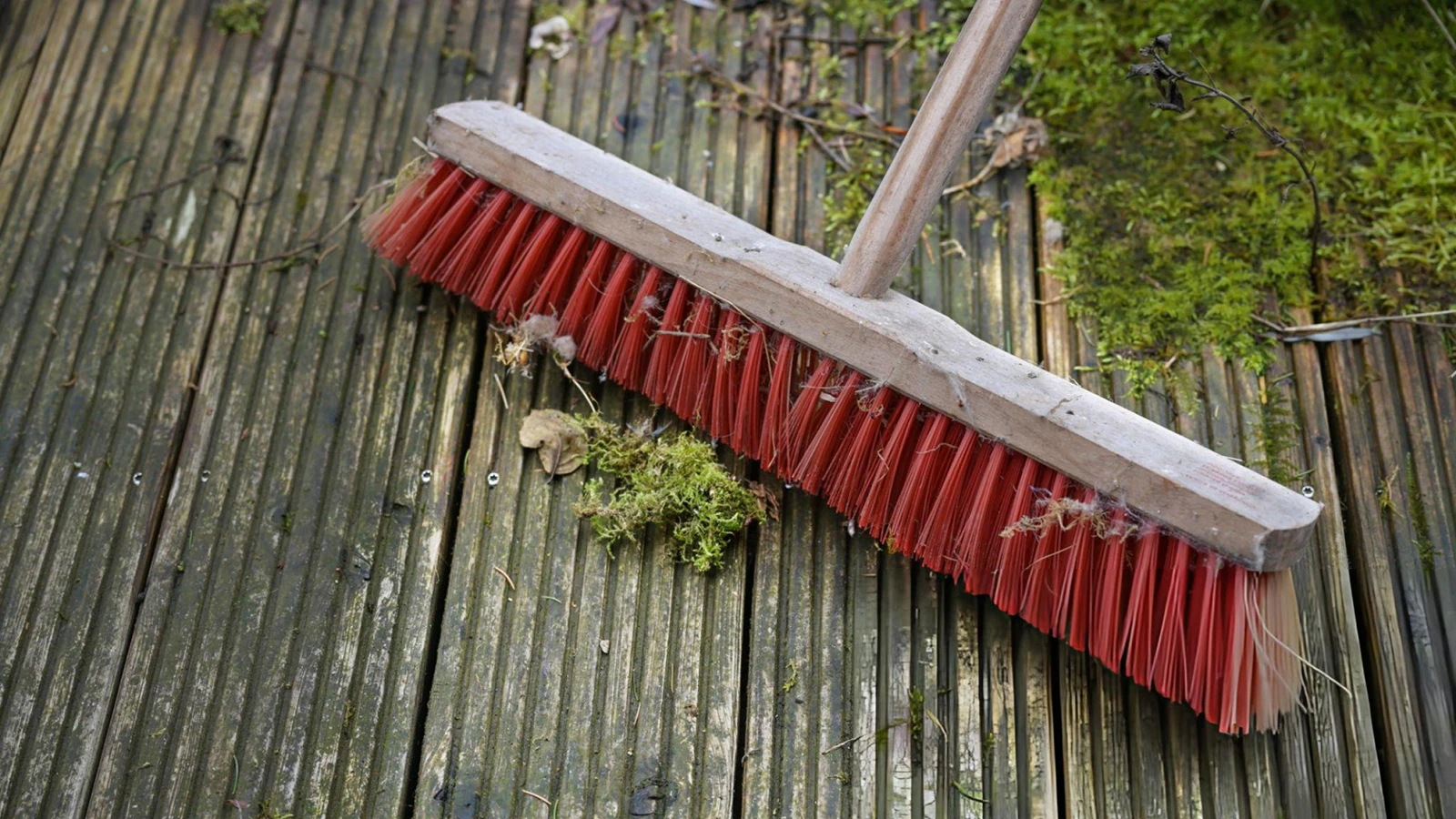
A push broom is a sweeping tool, not a scrubbing tool, and treating it as either leads to frustration. Its wide bristle band covers ground quickly, which is why every warehouse, workshop and loading bay relies on one. Bristle stiffness decides the debris it can move: soft synthetic bristles handle fine dust on smooth floors, medium bristles handle general debris, and stiff bristles handle gravel, sand and wet leaves on rough outdoor surfaces. Flagged bristles, which are split at the tips, sweep fine dust noticeably better than blunt ones. Meanwhile, a broom that is too stiff for the surface will simply skate over dust without picking it up.
Handle geometry is the other half of the decision. A broom with a threaded socket accepts a standard handle, which lets you match length to your height and posture, and a two-handed grip suits heavy sweeping. In addition, the head angle matters: an angled or offset head lets you sweep close to walls and under shelving without changing your stance. Push brooms wear unevenly, because most people sweep in one direction, so rotate the head periodically to even out the wear. We found that rotating the head every few weeks roughly doubled the useful life of a broom in a workshop environment.
Floor Squeegees and Water Removal
A floor squeegee does one job better than anything else in the category: it moves water. A single blade of rubber, foam or EVA sits flat against the floor and pushes a puddle ahead of it into a drain, a channel or a bucket. In a wet room, a commercial kitchen, a garage or a bathroom after a flood, that is the difference between a floor that dries in twenty minutes and one that stays damp for hours. Consequently, squeegees matter for slip safety as much as for appearance, and public health guidance on cleaning treats drying as a central step rather than a finishing touch (CDC, 2025). A wet floor is an unfinished job.
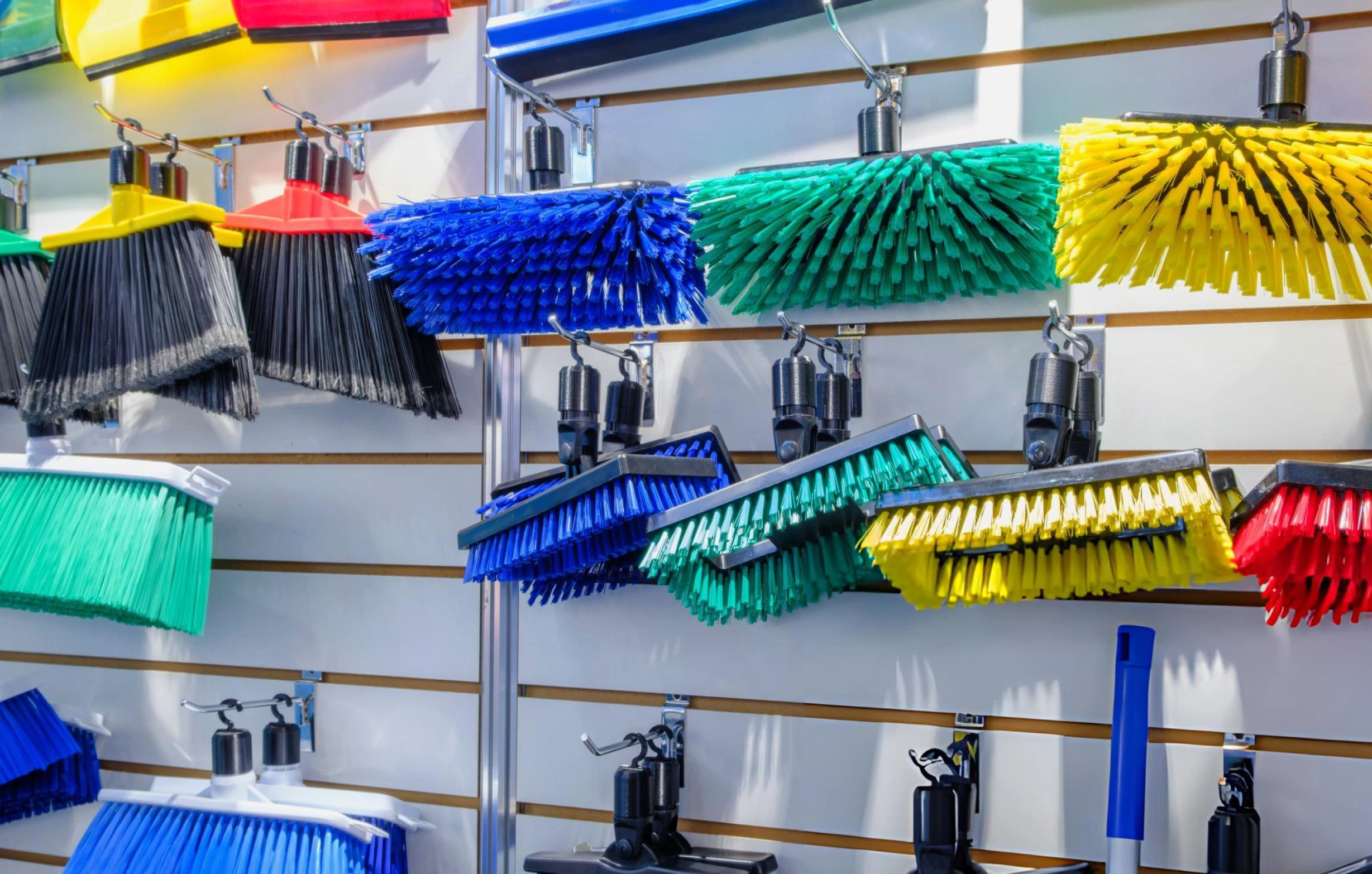
Blade material decides the squeegee’s character. Rubber blades grip smooth tile and push water efficiently, but they harden with age and eventually chatter across the surface. Foam and EVA blades conform to slightly uneven floors and are more forgiving on concrete, though they wear faster under heavy use. In addition, blade width trades speed against manoeuvrability: a 600 mm blade clears a corridor quickly but will not fit between fixtures. Notably, a squeegee blade must be kept clean, because a blade carrying grit will scratch a polished floor with every pass. Rinse it after use and store it hanging rather than resting on the edge. Similarly, a blade left flat on a wet floor will develop a curve that no amount of cleaning will remove.

JESUN Multifunction Magic Broom (FG-11)
A TPR blade on a 128 cm iron handle, 0.4 kg, that sweeps and pushes water in one pass. The hybrid to reach for when a floor is wet but not wet enough for a full squeegee run.
Grout, Edge and Detail Brushes
Detail brushes exist because the last five percent of a floor is the part everyone notices. A narrow stiff head cleans the grout line between tiles, the join where a floor meets a skirting board, the channel around a toilet base, and the corner under a cabinet that a wide brush never reaches. These brushes are usually hand-held, and their heads are thin so the bristles can follow a line rather than spreading across the surface. Specifically, a grout line holds soil that a flat scrub brush simply passes over, which is why a tile floor can look clean overall and still show dark lines between the tiles.
Two practical rules apply. First, use these brushes with light pressure, because thin heads and stiff tufts are the easiest combination to break. Second, keep detail brushes separate from floor scrubbers if you clean bathrooms, since a brush that has been along a toilet base should not return to a food preparation area. In our experience, a single narrow brush with a pointed tip covers grout lines, sink edges and appliance bases, which makes it the most versatile tool in the floor set despite being the smallest. Replacing one every six to twelve months is normal, and the cost is negligible. Similarly, keeping the head dry between uses is what prevents stiff tufts from clumping together.
Handles, Bristles and Backing
Three specifications decide how a floor brush performs, and none of them appear prominently on the packaging. Handle length sets your posture and leverage; a short handle forces you to bend, while a threaded socket lets you choose. Bristle stiffness sets what the brush can move without damaging the floor. Backing material sets how evenly pressure is distributed across the head. Getting all three right matters more than the price, because a well-specified inexpensive brush outperforms a badly specified premium one on most floors. Consequently, we recommend choosing stiffness and handle length first and treating price as the last consideration.
| Specification | Options | Choose it when | Avoid it when |
|---|---|---|---|
| Bristle stiffness | Soft, medium, stiff | Soft for resilient floors, stiff for concrete | Stiff on vinyl, laminate or polished stone |
| Bristle material | Nylon, PP, TPR, natural fibre | Nylon for abrasion, TPR for rinsing clean | Natural fibre where the brush stays wet |
| Handle | Short, long, threaded, telescopic | Long or threaded for large areas | Short handles for whole-room work |
| Backing | Wood, plastic, foam, thin composite | Solid backing for even pressure | Thin flexible backing for stiff bristles |
| Blade (squeegee) | Rubber, foam, EVA | Rubber for smooth tile, EVA for concrete | A worn or hardened blade on polished floors |
Matching the Brush to the Floor
Work from the floor material outward, and the tool choice becomes straightforward. The list below covers the common cases.
- Concrete and garage floors: stiff nylon scrub brush with a long handle, plus a foam-blade squeegee for rinsing water.
- Ceramic and porcelain tile: medium scrub brush for the field, plus a narrow detail brush for grout lines.
- Vinyl and laminate: soft or medium bristles only, and a rubber squeegee rather than a stiff brush for water.
- Polished stone and marble: soft brushes and a clean rubber blade, with no abrasive pad anywhere near the surface.
- Warehouse and workshop: a wide push broom for debris, a stiff scrubber for spills and an EVA squeegee for wet areas.
- Wet rooms and commercial kitchens: a floor squeegee as the primary tool, plus a stiff brush for the corners it cannot reach.
If you only buy three tools, buy a medium scrub brush, a wide push broom and a floor squeegee. Those cover scrubbing, sweeping and drying, which is everything a floor actually needs. Then add a detail brush when grout lines or edges become a visible problem, because that is the point at which a wide brush stops being sufficient. As a result, most households can start with three tools and add the fourth only when a specific problem appears.
Cleaning, Drying and Replacing Floor Brushes
Floor brushes get dirtier than any other cleaning tool, because they work on the largest and most contaminated surfaces in a building. Rinse the bristles thoroughly after every use, shake out the excess water, and hang the brush head-up so air reaches the backing as well as the tips. Once a week, wash the head in hot soapy water and let it dry completely before it goes back into service. In addition, wash the handle, because it is the part your hands touch and it collects as much contamination as the head. A brush that is stored wet will smell, splay faster and spread residue across the next floor it touches.
Replacement is driven by contact rather than appearance. A scrub brush is finished when the bristle tips shorten enough that the head no longer sits flat on the floor, or when the tufts splay so far that pressure no longer reaches the surface. Some commercial machine brushes solve this with wear-indicator bristles — a band of shorter yellow tufts that disappears when the brush is due for replacement — and that is the most objective signal in the category, even though hand brushes rarely carry it. In practice, a hand scrub brush lasts six to twelve months in a household and considerably less in commercial daily use. Those figures are the ranges we work to as a manufacturer rather than the results of a published wear test, so treat them as a starting point and shorten them if the brush is used daily or with bleach. Squeegee blades need replacing when they harden, develop a nick or start leaving a thin trail of water behind the pass. Meanwhile, push brooms last longest of all, but only if you rotate the head and keep the bristles dry between uses. However, a broom with a cracked socket should be retired, because the head will detach under load.
Часто задаваемые вопросы
What are the main types of floor brushes?
Four working groups cover floor care: scrubbing and deck brushes for lifting dried soil, push brooms for moving loose debris, floor squeegees for pushing standing water to a drain, and narrow detail brushes for grout lines and edges. Most buildings need at least three of the four.
What is the difference between a floor brush and a floor squeegee?
A floor brush has bristles and removes soil by abrasion. A floor squeegee has a single rubber, foam or EVA blade and removes standing water by pushing it. They are not interchangeable: a brush will not clear a puddle, and a squeegee will not lift dried soil.
Which bristle stiffness should I use on tile floors?
Medium stiffness for ceramic and porcelain tile, with a stiff narrow brush for the grout lines and a soft brush for polished or glazed finishes. Avoid stiff nylon on vinyl, laminate and polished stone, where it leaves fine scratches that dull the surface.
How do I stop a floor brush from smelling?
Rinse it thoroughly after every use, shake out the water, and hang it head-up so the backing dries as well as the bristles. Wash the head and handle weekly in hot soapy water. A brush stored wet in a bucket or on the floor will develop a smell within weeks.
How often should floor brushes be replaced?
Replace a household scrub brush every six to twelve months, and a commercial one more often. The signal is contact rather than appearance: once the bristle tips shorten or splay enough that the head no longer sits flat on the floor, the brush has stopped cleaning properly.
Sourcing floor brushes and squeegees?
We manufacture deck and scrub brushes, push brooms, floor squeegees and detail brushes in nylon, PP, TPR and EVA, with threaded and telescopic handles, and OEM or ODM support from low MOQs.
Request Wholesale Pricing →Заключение
Floor brushes split into four jobs that cannot substitute for each other: scrubbing, sweeping, water removal and detail work. Scrubbing brushes lift dried soil and are the only group that actually cleans a stained floor, but they damage resilient surfaces if the bristles are too stiff. Push brooms cover ground fast and last for years when the head is rotated. Squeegees are the only tool that removes standing water, which makes them a safety tool rather than a finishing touch. Detail brushes handle the last five percent that everyone notices. That said, none of them perform well if they are stored wet, so drying remains the habit that decides both hygiene and lifespan.
We build all four groups in a range of bristle materials and handle lengths, and we are glad to help you match a floor care set to the surfaces your market actually cleans.
Ссылки
- Westwood JCN, Mitchell MA, Legacé S — “Hospital Sanitation: the Massive Bacterial Contamination of the Wet Mop,” Applied Microbiology 21(4):693–697, 1971. journals.asm.org/doi/10.1128/am.21.4.693-697.1971
- US Centers for Disease Control and Prevention — “When and How to Clean and Disinfect Your Home.” cdc.gov/hygiene/about/when-and-how-to-clean-and-disinfect-your-home.html
- Consumer Reports — “Household Cleaning Tools: How to Clean and When to Replace.” consumerreports.org/home-garden/cleaning/how-to-clean-and-when-to-replace-household-cleaning-tools
- University of Illinois Extension — “A guide to keeping your sponges, dish rags and scrub brushes clean.” extension.illinois.edu/blogs/simply-nutritious-quick-and-delicious
This guide was written by the JESUN Cleaning Tools Team and reviewed by our product engineering group. You can read more about us или contact our team with questions about floor brush specifications.
Continue Learning
- Различные виды метел: каталог для покупателей B2B. — the sweeping side of floor care in more depth.
- How to Clean Indian Sandstone Paving Slabs — outdoor stone, where brush stiffness matters most.
- Brush catalog — deck, scrub and detail brushes for every floor type.
- Floor squeegee catalog — rubber, foam and EVA blades with long handles.




 Russian
 English
 Spanish
 Arabic